




Digital marketing moves fast, and so does its language. Whether you are launching your first online business, briefing an agency, or building a career in marketing, knowing the vocabulary makes every conversation easier and every decision sharper.
This guide walks through 50 essential terms, grouped by theme rather than alphabetically, so you can see how the pieces fit together. Each entry explains what the term means and why it matters in practice.
Part 1: Strategy and Planning
Every good campaign starts with a plan. These ten terms are the foundation.
1. Digital Marketing
Digital marketing covers every effort to promote a brand, product, or service through online channels: search engines, social platforms, email, websites, apps, and more. Its biggest advantage over traditional marketing is measurability, because almost every action can be tracked.
2. Marketing Plan
A marketing plan is a written roadmap of your goals, target audience, channels, budget, and timeline, usually covering a quarter or a year. Without one, activity tends to replace strategy.
3. Market Research
Market research is the systematic gathering of information about your customers, competitors, and industry. Surveys, interviews, social listening and competitor audits all help you replace assumptions with evidence before spending budget.
4. Buyer Persona
A buyer persona is a semi-fictional profile of your ideal customer, built from real data: age, role, goals, habits, objections, and the places they spend time online. Strong personas keep messaging specific instead of generic.
5. Customer Journey
The customer journey is the full path a person takes from first hearing about you to buying and, ideally, becoming a repeat customer. Mapping it reveals where people get confused, lose interest, or drop out.
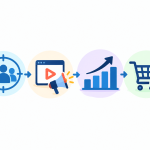
6. Marketing Funnel
The marketing funnel breaks the journey into stages, typically awareness, consideration, and decision, sometimes followed by loyalty and advocacy. Each stage calls for different content: a blog post suits awareness, while a case study or demo suits decision.
7. KPI (Key Performance Indicator)
A KPI is a measurable number tied to a business goal, such as cost per lead, click-through rate or revenue per channel. The key word is key: choose a handful that reflect real outcomes rather than tracking everything.
8. B2B Marketing
Business-to-business marketing targets companies and organisations. Sales cycles are longer, several people often take part in the decision, and trust, expertise, and ROI proof matter more than impulse.
9. B2C Marketing
Business-to-consumer marketing targets individual buyers. Decisions are usually faster and more emotional, so brand personality, convenience, social proof, and price messaging play a bigger role.
10. Growth Hacking
Growth hacking is a mindset of running many fast, low-cost experiments to find the quickest route to growth. It is especially popular with startups, but any team can borrow the habit of testing small ideas and keeping what works.
Part 2: Content and Storytelling
Content is how brands earn attention instead of simply buying it.
11. Content Marketing
Content marketing means creating and sharing useful, relevant material, such as articles, videos, guides, and podcasts, to attract a defined audience and guide it toward becoming customers. The goal is to be helpful first and persuasive second.
12. Inbound Marketing
Inbound marketing draws people in with content and experiences they actually want, rather than interrupting them. It combines content, SEO, social media, and email to build trust over time.
13. Outbound Marketing
Outbound marketing is the opposite approach: the company starts the conversation through TV and radio ads, print, cold calls, or mass emails. It can deliver reach quickly, but it works best when targeting is precise and the message is relevant.
14. Blog
A blog is a regularly updated section of a website where articles appear, newest first. For businesses, it is a long-term asset that supports search visibility, demonstrates expertise and gives you something valuable to share on social media and in email.
15. eBook
An eBook is a downloadable long-form guide on a specific topic. Companies often offer one in exchange for an email address, which makes it a classic lead-generation tool.
16. Whitepaper
A whitepaper is an in-depth, research-driven report that explains a complex problem and a proposed solution. It is more formal and data-heavy than an eBook and is particularly effective in B2B sales.
17. Infographic
An infographic turns data or a process into a clear visual. It is easy to scan, easy to share, and useful for explaining numbers or steps that would be dull as plain text.
18. Webinar
A webinar is a live or recorded online presentation, often with Q&A. It lets you show expertise, interact with prospects in real time, and collect leads who have already shown genuine interest in a topic.
19. Viral Marketing
Viral marketing relies on audiences sharing content with each other, so reach grows like word of mouth at scale. Virality cannot be guaranteed, but content that is surprising, emotional, or genuinely useful has a better chance.
Part 3: Search and Discoverability
Being found at the moment someone is looking is one of the most valuable things a brand can achieve.
20. SEO (Search Engine Optimization)
SEO is the practice of improving your website so it appears higher in unpaid search results. It covers content quality, technical health, site structure and authority, and it tends to pay off slowly but durably.
21. On-Page SEO
On-page SEO covers everything you control on the page itself: titles, headings, meta descriptions, internal links, image descriptions, page speed, and the relevance of the copy. Think of it as making your content easy for both people and search engines to understand.
22. Off-Page SEO
Off-page SEO builds your site’s reputation beyond its own pages, mainly through links from other credible websites, brand mentions, and digital PR. Quality matters far more than quantity.
23. Keyword
A keyword is a word or phrase people type into a search engine. Choosing the right ones means balancing search volume, competition and, above all, how closely they match what your business offers.
24. Search Intent
Search intent is the reason behind a query: to learn something, find a specific site, compare options, or buy. A page that matches the intent behind a keyword will almost always outperform one that merely contains it.
25. Backlink
A backlink is a link from another website to yours. Search engines treat links from trusted, relevant sites as votes of confidence, which is why earning them through useful content and partnerships remains a core SEO activity.
26. SEM (Search Engine Marketing)
SEM refers to promoting your site on search engines, most commonly through paid search ads that appear above or alongside organic results. It delivers quick visibility and is easy to switch on or off.
27. Generative Engine Optimization (GEO)
GEO is the emerging practice of making your content easy for AI-powered search tools and assistants to find, understand, and cite. In practice, it rewards clear structure, direct answers, credible sources, and a recognisable brand, many of the same habits as good SEO.
Part 4: Paid Advertising and Partnerships
Paid channels let you buy speed and precision.
28. PPC (Pay-Per-Click)
In pay-per-click advertising, you pay only when someone clicks your ad. It is the model behind most search and social ads, and it rewards advertisers who pair relevant targeting with strong landing pages.
29. Paid Media
Paid media is any promotion you pay to place, including search ads, social ads, sponsored content, and display banners. It works best alongside owned and earned channels rather than as a replacement for them.
30. Display Advertising
Display ads are visual ads, such as banners and rich media, shown across websites, apps and video platforms. They are most useful for building awareness and reminding people who have already visited your site.
31. Social Media Advertising
Social media advertising lets you target people on platforms like Instagram, Facebook, LinkedIn or TikTok by interests, behaviours, and demographics. Creative that feels native to the platform usually outperforms polished but out-of-place ads.
32. Retargeting
Retargeting (or remarketing) shows ads to people who have already interacted with your brand, for example by visiting a product page or abandoning a cart. Because these audiences already know you, conversion rates are often higher.
33. Affiliate Marketing
In affiliate marketing, partners promote your product and earn a commission for each sale or lead they bring in. You only pay for results, which makes it attractive for e-commerce brands.
34. Influencer Marketing
Influencer marketing means collaborating with creators who have a loyal audience and credibility in a niche. Fit and trust matter more than follower count, and smaller creators often deliver stronger engagement.
Part 5: Social, Email and Automation
These channels help you build relationships rather than just generate clicks.
35. Community Manager
A community manager runs a brand’s presence on social networks: planning content, replying to followers, moderating conversations, and reporting on results. They are the human voice of the brand online.
36. Email Marketing
Email marketing sends promotional and informational messages directly to subscribers. It remains one of the most reliable channels for nurturing leads and driving repeat purchases because you own the list.
37. Marketing Automation
Marketing automation uses software to run repetitive tasks, such as welcome sequences, lead nurturing, and follow-up reminders, based on what people do. It saves time and keeps communication consistent as your audience grows.
38. Chatbot
A chatbot is software that converses with visitors through a website, app or messaging platform. Modern AI-based bots can answer common questions, qualify leads and book appointments around the clock, handing over to a human when needed.
Part 6: Website and User Experience
Your website is where most journeys either convert or end.
39. Landing Page
A landing page is a standalone page built for one campaign and one goal, such as signing up, downloading, or buying. By removing distractions like extra navigation, it focuses the visitor on a single action.
40. Responsive Design
A responsive website adapts its layout to any screen size, from phones to widescreen monitors. With so much browsing happening on mobile, it is no longer optional.
41. CMS (Content Management System)
A CMS lets you create and edit website content without writing code. WordPress, Shopify, Wix, and Squarespace are popular examples, and the right choice depends on your needs for flexibility, e-commerce, and ease of use.
42. UX Design
User experience design shapes how a product feels to use, including navigation, clarity, speed and how easily people reach their goal. Good UX is often invisible; poor UX is felt immediately.
43. UI Design
User interface design focuses on the visual layer: layout, colours, typography, buttons and icons. It works hand in hand with UX to make a product both attractive and easy to use.
44. Domain and Web Hosting
A domain is your website’s address, such as yourbrand.com, while hosting is the server space where the site’s files live. Reliable hosting affects speed, security, and uptime, all of which influence both user trust and search performance.
Part 7: Data, Testing and Lead Management
Measurement turns marketing from guesswork into a learning process.
45. Bounce Rate
Bounce rate is the percentage of visits in which someone views only one page and leaves.
Bounce rate (%) = single-page visits ÷ total visits × 100
A high figure is not always bad, since a visitor may have found their answer immediately, but on a landing page it can signal a mismatch between promise and content.
46. Conversion Rate
Conversion rate is the share of visitors who complete a desired action.
Conversion rate (%) = conversions ÷ total visitors × 100
The action might be a purchase, a form submission, or a newsletter signup. It is one of the clearest measures of whether your page, offer and audience are aligned.
47. A/B Testing
A/B testing compares two versions of a page, email, or ad to see which performs better. Change one element at a time, such as a headline or button, and let the test run long enough to reach a trustworthy result.
48. First-Party Data
First-party data is information you collect directly from your audience, such as purchases, signups, and site behaviour. As privacy rules tighten and third-party tracking declines, it has become one of a marketer’s most valuable assets, provided it is collected transparently and with consent.
49. Lead Generation
Lead generation is the process of attracting people who show interest in what you offer and capturing their contact details, typically through content downloads, events, forms or campaigns.
50. Lead Scoring
Lead scoring assigns points to leads based on who they are and how they behave, for example, job title, pages visited, or emails opened. It helps sales teams focus on the people most likely to buy and shows marketing which activities attract quality leads.
Putting the Vocabulary to Work
Learning these terms is only the first step. The real value comes from seeing how they connect: research shapes your personas, personas inform your content, content feeds your search presence, paid media amplifies it, and data tells you what to improve next.
A simple way to start is to pick three terms from this list that your business is not yet using well, perhaps retargeting, A/B testing, or lead scoring, and run one small experiment with each over the next quarter. Measure the results, keep what works and build from there.
If you would like help turning these ideas into a working strategy, a good digital marketing partner can help you prioritise channels, set the right KPIs, and execute consistently.