






Artificial intelligence is no longer a distant promise. It writes our emails, summarizes our meetings, helps doctors read scans, and lets small businesses compete with giants. Yet for all the excitement, many people and organizations still ask the same question: how do we actually move ahead with AI and get better outcomes, not just more noise?
The answer isn’t buying the newest tool or chasing every trend. It’s about being deliberate. Here is a practical roadmap for turning AI from a buzzword into a real advantage.
Why Better Outcomes Matter More Than Bigger Technology
Many AI projects fail, and the cause is rarely the technology. Teams adopt AI because everyone else is, without defining what success looks like. They end up with impressive demos and no measurable improvement.
Better outcomes means asking different questions. Instead of “How can we use AI?”, ask “What problem are we trying to solve, and could AI help?” That small shift keeps you focused on results like saved time, lower costs, happier customers, and better decisions rather than on novelty.
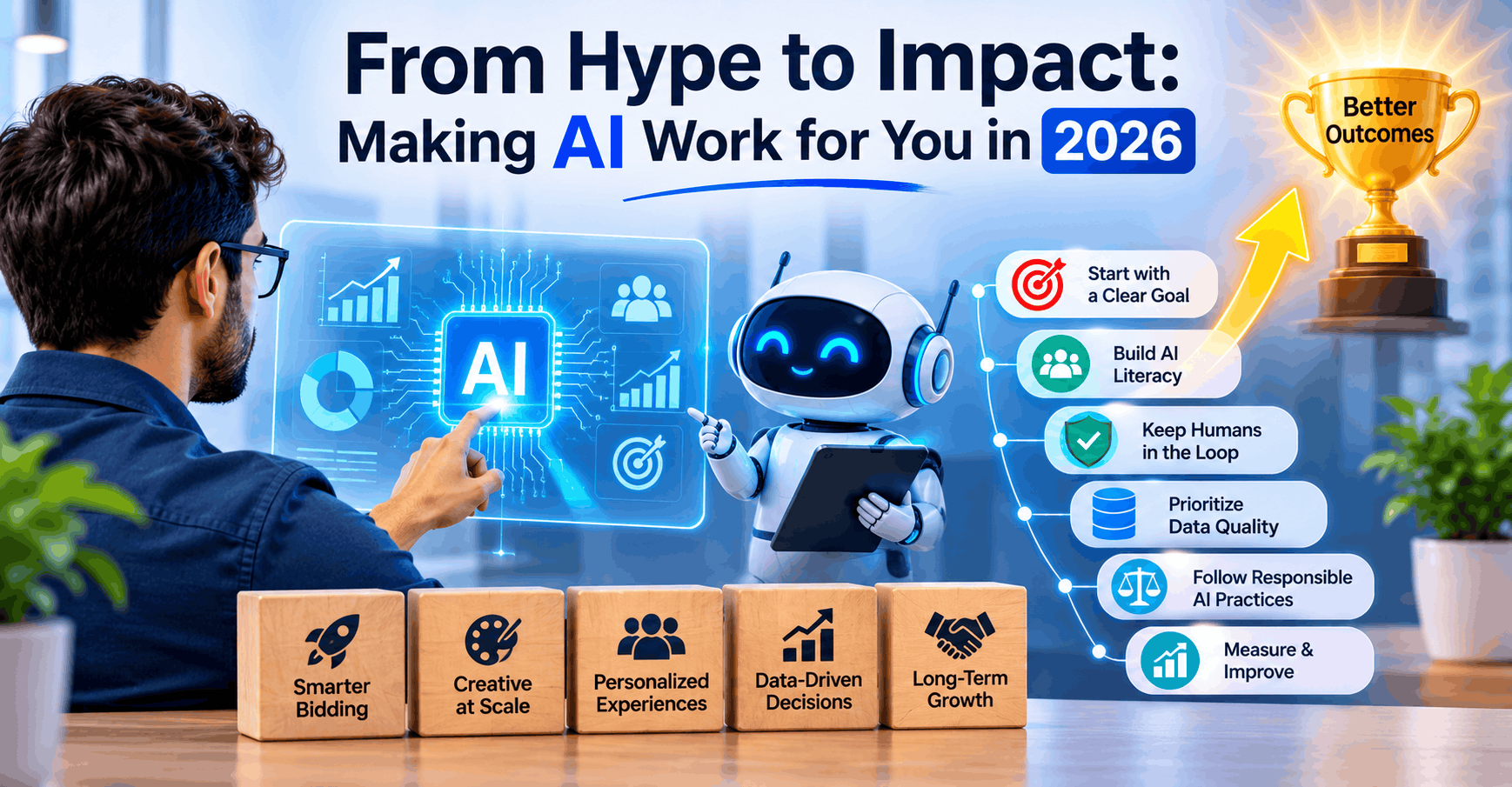
Step 1: Start with a Clear Problem, Not a Tool
The most successful AI efforts begin with a specific pain point. Maybe your support team is overwhelmed by repetitive questions. Maybe your marketing team spends hours on first drafts. Maybe your analysts lose days cleaning data.
Pick one or two problems where:
- The task is repetitive or time-consuming
- The data or inputs are available
- Success can be measured (hours saved, errors reduced, response time improved)
Starting small builds confidence and gives you evidence. A modest win that you can measure is worth more than an ambitious project that never ships.
Step 2: Build AI Literacy Across Your Team
You can’t get good results from tools people don’t understand. AI literacy doesn’t mean everyone becomes a data scientist. It means everyone knows:
- What AI can and cannot do well
- How to write clear prompts and give useful context
- Why outputs need to be checked rather than trusted blindly
- When not to use AI
Invest in upskilling. Short workshops, shared prompt libraries, and internal “show and tell” sessions go a long way. People who feel confident with AI use it more creatively, and people who feel threatened by it resist it. Training turns fear into curiosity.
Step 3: Keep Humans in the Loop
AI is powerful, but it is not infallible. It can sound confident while being wrong, a problem often called hallucination. It can reflect biases hidden in its training data. And it lacks the judgment, empathy, and accountability that humans bring.
The best outcomes come from human-AI collaboration. Let AI handle the heavy lifting: first drafts, pattern spotting, summarizing, and routine automation. Let people do what they do best: setting direction, applying context, making ethical calls, and building relationships.
A good rule of thumb is that the higher the stakes, the more human review you need. A social media caption can go out with a quick glance. A medical, legal, or financial decision needs a qualified person to verify every important detail.
Step 4: Put Data Quality and Privacy First
AI is only as good as the information behind it. Messy, outdated, or biased data produces unreliable results, no matter how advanced the model is. Before scaling AI, take time to:
- Clean and organize your key data sources
- Document where your data comes from
- Set clear rules about what information can and cannot be shared with AI tools
Privacy deserves special attention. Never paste confidential customer details, passwords, or sensitive company information into tools without understanding how that data is stored and used. Trust is hard to earn and easy to lose, and a single data slip can undo years of goodwill.
Step 5: Build Responsible AI Practices
Responsible AI isn’t a box to tick at the end. It’s a foundation. As AI becomes part of daily operations, organizations need simple, clear guardrails:
- Transparency: Tell people when AI is being used and how.
- Fairness: Test outputs for bias, especially in hiring, lending, or any decision affecting people’s lives.
- Accountability: Decide who is responsible when something goes wrong.
- Security: Protect systems against misuse and data leaks.
Governance doesn’t have to be bureaucratic. A one-page AI policy that everyone understands is better than a 50-page document no one reads. Regulations around the world are also tightening, so building good habits now saves headaches later.
Step 6: Measure, Learn, and Improve
What gets measured gets improved. Before launching any AI initiative, define a few simple metrics tied to your original problem:
- Time saved per task or per week
- Quality improvements, such as fewer errors or higher customer satisfaction
- Cost reduction or revenue growth
- Adoption rate, meaning how many people actually use the tool
Review these regularly. If something isn’t working, adjust your approach, retrain your team, or retire the tool. Treat AI as an ongoing experiment, not a one-time installation. The technology is evolving quickly, and the organizations that win are the ones that keep learning.
Step 7: Prepare for the Next Wave: AI Agents and Automation
The next phase of AI goes beyond answering questions. AI agents can plan, take actions, and complete multi-step tasks on our behalf, such as researching a topic, scheduling meetings, or processing orders. That opens enormous potential for productivity, but it also raises the stakes for oversight.
To prepare, start giving AI small, well-defined tasks with clear boundaries. Review what it does. Gradually expand its responsibilities as trust and performance are proven. Think of it like onboarding a new team member: you start with simple assignments, check the work, and increase independence over time.
Common Mistakes to Avoid
Even well-meaning teams stumble. Watch out for these traps:
- Chasing trends: Adopting tools without a clear purpose wastes time and money.
- Ignoring the people’s side: Technology succeeds only when people are on board.
- Over-trusting outputs: Always verify important facts, figures, and claims.
- Skipping governance: Weak policies create risks that surface at the worst moment.
- Expecting overnight transformation: Real gains come from steady, compounding improvements.
What AI Can Do for Individuals
This isn’t only about big organizations. Freelancers, students, and professionals can all benefit. Use AI to brainstorm ideas, draft and polish writing, learn new subjects faster, organize your schedule, or analyze information. The key is to stay in the driver’s seat: use AI to extend your thinking, not replace it. People who combine strong fundamentals with smart AI use will stand out in the years ahead.
The Bigger Picture: AI for Good
Beyond productivity, AI has the potential to improve lives at scale. It’s helping detect diseases earlier, predict extreme weather, personalize education, and make services more accessible to people with disabilities. Whether these benefits reach everyone depends on the choices we make now: building inclusively, sharing knowledge widely, and keeping human well-being at the center of every decision.
Final Thoughts
Moving ahead with AI isn’t about racing to adopt every new tool. It’s about being intentional: start with real problems, train your people, keep humans involved, protect your data, act responsibly, and measure what matters. Do these things consistently and AI becomes less of a risk and more of a reliable partner.
The future won’t belong to those who simply use AI the most. It will belong to those who use it the best, with clarity, care, and a commitment to better outcomes for everyone.
So where will you begin? Pick one problem, try one small experiment, and learn from the result. That single step is how every meaningful AI journey starts.