




Performance marketing has always been a numbers game. Every click, impression and conversion is tracked, and every rupee or dollar is expected to justify itself. For years, marketers won this game by being faster and more disciplined than their competitors: tweaking bids, splitting audiences and testing headlines by hand.
That era is ending. Artificial intelligence now sits inside nearly every major ad platform, and it is changing how campaigns are built, optimized and measured. Used well, AI ads can lower acquisition costs, scale creative production and uncover audiences no human analyst would find. Used carelessly, they can burn budget, flatten your brand and hide problems behind a black box.
This post breaks down where AI is making the biggest difference in performance marketing, where the risks lie, and how to put it to work without losing control of your results.
What We Mean by “AI Ads”
The phrase covers several different things, and it helps to separate them:
- Automated bidding and budgeting, where machine learning adjusts bids in real time based on the likelihood of a conversion.
- Automated campaign formats, such as Google’s Performance Max or Meta’s Advantage+, which choose placements, audiences and creative combinations on your behalf.
- Generative AI for creative, which produces headlines, copy, images and even video variations at scale.
- Predictive analytics, which forecasts customer value, churn and likely purchase behavior.
Each of these touches a different part of the performance funnel, and each affects your metrics differently.
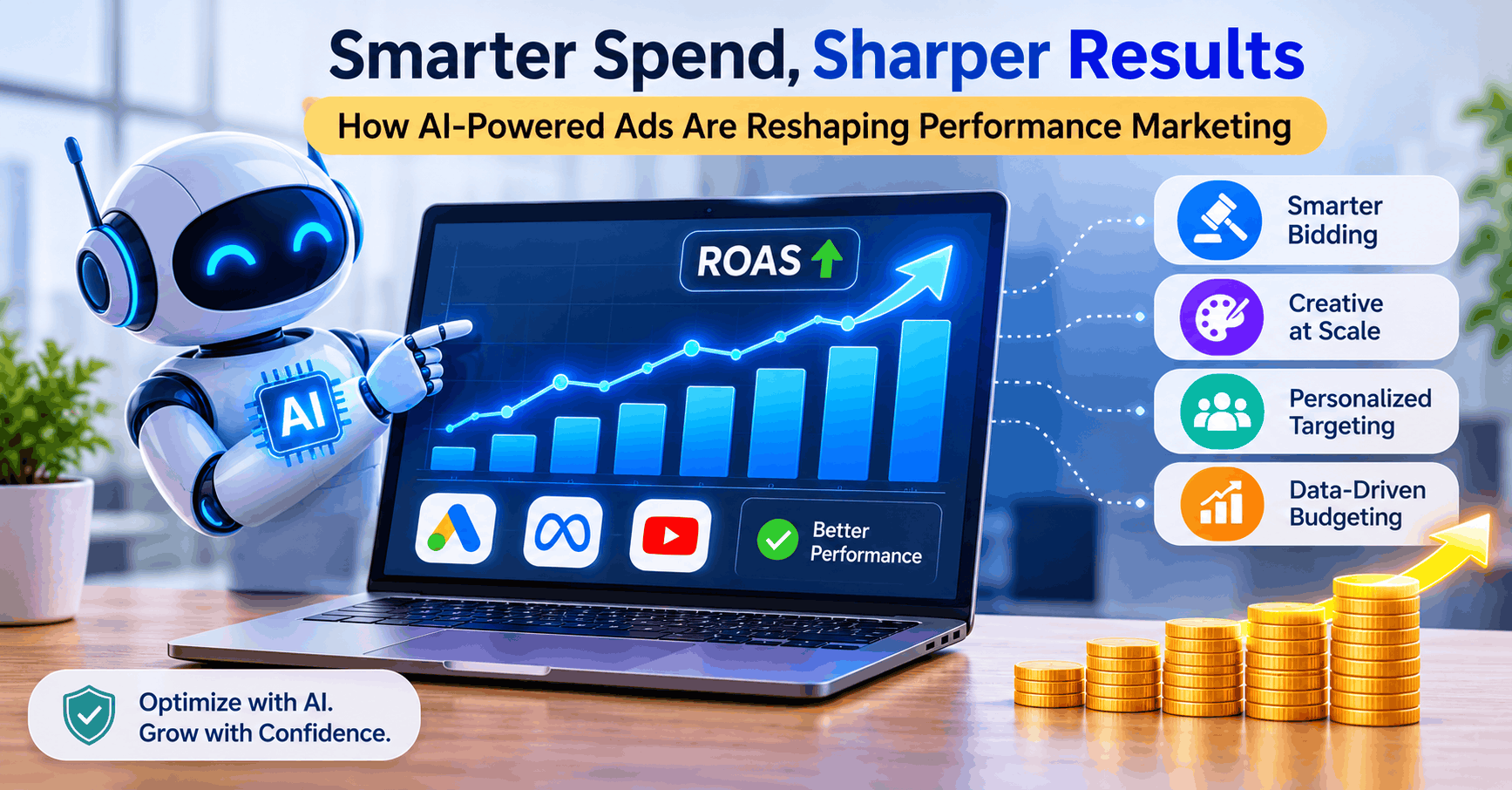
1. Smarter Bidding Lowers Wasted Spend
The most mature use of AI in advertising is bidding. A human manager might adjust bids once a day or once a week. An algorithm can adjust them for every single auction, weighing hundreds of signals at once: device, location, time of day, browsing history, past purchase behavior and more.
The impact on performance is usually visible in two places. First, cost per acquisition (CPA) tends to fall because the system stops bidding aggressively on users unlikely to convert and leans in on the ones who are. Second, return on ad spend (ROAS) improves as budget shifts toward the highest-value traffic.
The catch is that these systems need data. Smart bidding performs best with a steady stream of conversions, typically dozens per month per campaign at minimum. Small accounts or niche products can see unstable results during the learning phase. If your conversion volume is low, consider optimizing toward an earlier funnel event, like an add-to-cart, until you have enough signal.
2. Creative Testing at a Scale Humans Cannot Match
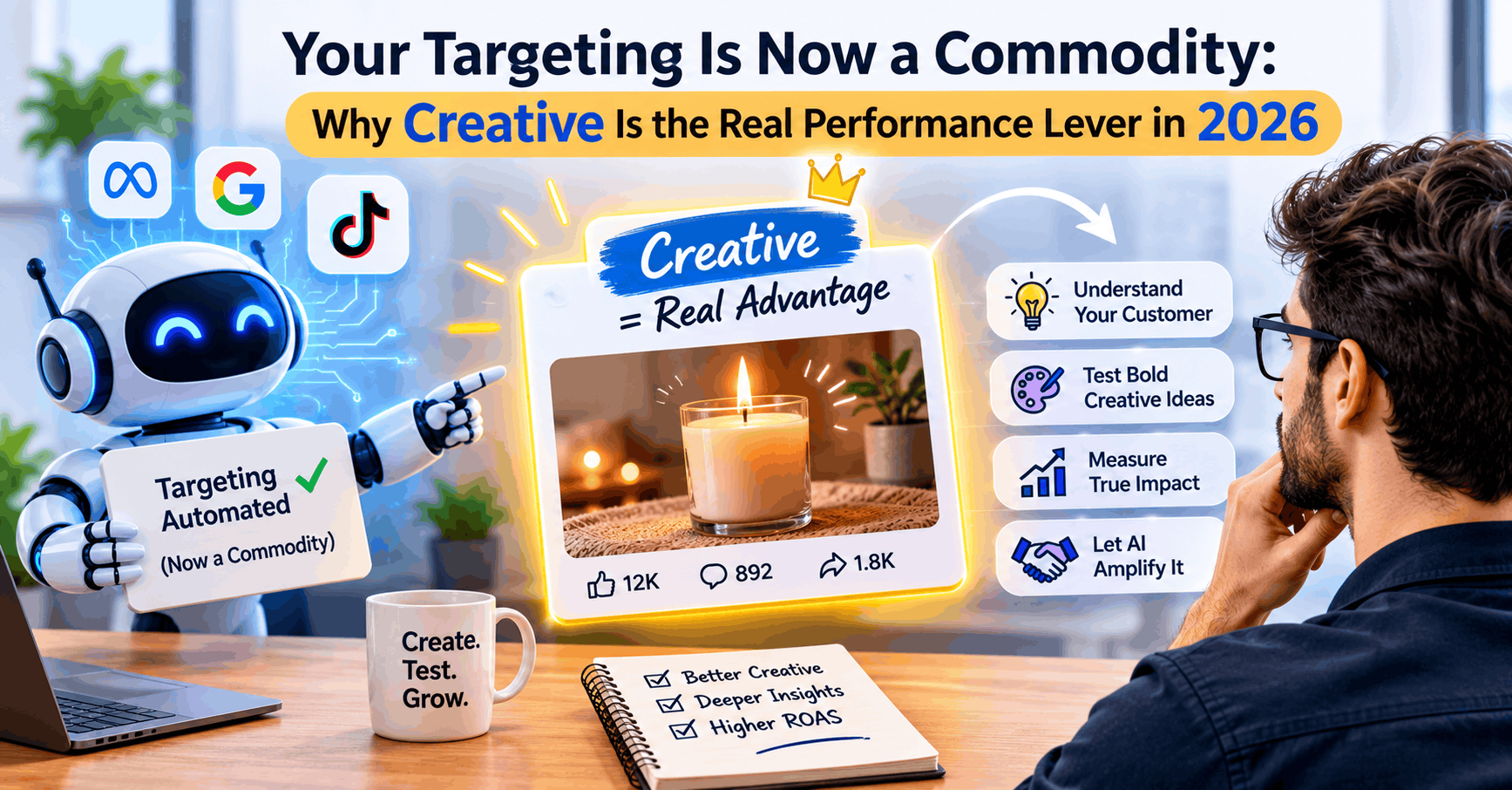
Creative is now the biggest performance lever in paid media. As targeting options narrow due to privacy changes, the ad itself does more of the work of finding the right customer. A strong message resonates with the right people and the platform’s algorithm learns from that response.
Generative AI changes the economics of creative testing. Instead of producing five ad variations a month, a team can produce fifty. AI can draft multiple headlines, rewrite copy for different audience segments, resize assets for every placement and generate image or video concepts in minutes.
This has three direct performance benefits:
- Faster learning. More variations mean the platform finds winning combinations sooner.
- Reduced creative fatigue. Audiences get tired of seeing the same ad. A constant supply of fresh variations keeps click-through rates healthy.
- Lower production costs. Smaller brands can compete visually with bigger ones without large studio budgets.
But volume is not quality. AI-generated creative can drift toward the generic, and when every competitor uses the same tools, ads start to look and sound alike. The brands that win use AI for speed and variation, while humans supply the core insight, the brand voice and the final judgment.
3. Sharper Audience Discovery and Personalization
Traditional targeting relied on marketers guessing who their customers were: women aged 25 to 34 interested in fitness, for example. AI-driven systems work the other way around. They study who actually converts and then find more people who behave similarly, including groups a marketer would never have thought to target.
This broad, signal-led approach often uncovers new pockets of demand. It also enables personalization at scale. Dynamic ads can adapt the product, message and offer to each viewer based on their behavior. Someone who abandoned a cart sees the exact product they left behind, while a first-time visitor sees a brand introduction.
Predictive models take this further. By estimating customer lifetime value early, AI can help you bid more for users who will become loyal, high-spending customers and less for one-time bargain hunters. That shifts your optimization target from cheap conversions to profitable ones, which is where real performance gains come from.
4. Better Forecasting and Budget Allocation
Performance marketers constantly face the same question: where should the next dollar go? AI-powered analytics and marketing mix models can answer this with more nuance than a simple last-click report.
These tools can estimate how channels work together, flag diminishing returns on saturated campaigns and forecast outcomes before you commit budget. In a world where tracking is increasingly fragmented by privacy rules and cookie restrictions, modeled attribution fills gaps that deterministic tracking can no longer cover.
The result is fewer gut-feel budget decisions and a clearer view of incremental impact, meaning the sales that would not have happened without your ads.
The Risks Performance Marketers Should Not Ignore
AI ads are powerful, but they are not magic. Several risks deserve attention.
The black box problem. Automated campaigns often reveal limited information about where your ads ran and why they performed. When results are good, this is fine. When they decline, diagnosing the cause is harder.
Optimizing for the wrong goal. An algorithm does exactly what you tell it to do. If you optimize for form fills but your sales team finds those leads worthless, the AI will happily deliver more worthless leads. Feeding the system high-quality conversion data, such as qualified leads or actual revenue, is critical.
Brand safety and consistency. Generative tools can produce off-brand, inaccurate or tone-deaf content. Without review, a small error can be multiplied across thousands of ad variations.
Over-reliance on platform reporting. Ad platforms grade their own homework. Their AI will often claim credit for conversions that would have happened anyway, especially from branded search and retargeting. Independent measurement matters.
Data privacy and compliance. AI systems depend on customer data. Marketers must stay compliant with regulations, collect consent properly and be transparent about how data is used.
How to Make AI Ads Work for Your Performance Goals
The teams getting the best results treat AI as a capable junior partner, not an autopilot. Here is a practical approach.
Start with clean, accurate data. Fix your conversion tracking first. Use server-side tagging and first-party data where possible, and pass back real business outcomes like revenue and profit margin, not just clicks.
Set clear, measurable goals. Decide whether you are optimizing for volume, efficiency or profit, and configure your bidding strategy to match. Different goals call for different settings.
Give the algorithm room to learn. Constant tinkering resets the learning phase and wastes spend. Make deliberate changes, then wait for enough data before judging.
Feed it great creative. Provide diverse assets: different formats, angles and messages. The better the raw material, the better the system can optimize. Keep humans in charge of strategy, brand voice and approval.
Test incrementality. Run holdout tests or geo experiments to confirm your ads are driving additional sales, not just claiming credit for existing demand.
Monitor and set guardrails. Use exclusions, brand safety controls and budget caps. Review placement and search term reports where available, and audit AI-generated content before it goes live.
What the Future Looks Like
The direction is clear. Ad platforms are moving toward end-to-end automation, where a marketer supplies a goal, a budget, a few assets and a landing page, and the system handles the rest. Conversational interfaces, AI-generated video and real-time creative personalization will become standard.
As this happens, the marketer’s role shifts. Less time goes into manual bid adjustments and audience setup, and more goes into strategy, creative direction, data quality and measurement. The advantage will belong to teams that understand their customers deeply, feed the machines good inputs and question the outputs.
Final Thoughts
AI ads are already reshaping performance marketing by lowering waste, multiplying creative testing, uncovering new audiences and sharpening budget decisions. The potential upside is significant, but so is the risk of handing over control without understanding what is happening underneath.
The winning formula is simple to state and harder to practice: let AI handle the speed and scale, and keep humans responsible for the goals, the story and the truth in the data. Marketers who strike that balance will not just keep up with the change. They will use it to build more efficient, more profitable and more resilient growth engines.