





A few years ago, I sat in a review meeting where a media buyer proudly showed a spreadsheet. It had 47 audience segments, each with its own lookalike percentage, interest stack, and exclusion list. It had taken two weeks to build. The campaign ran for a month and performed almost identically to the broad-targeting test someone had set up on a Friday afternoon “just to see.”
The room went quiet. Nobody said it out loud, but we all felt it: the thing we had been proud of was no longer the thing that mattered.
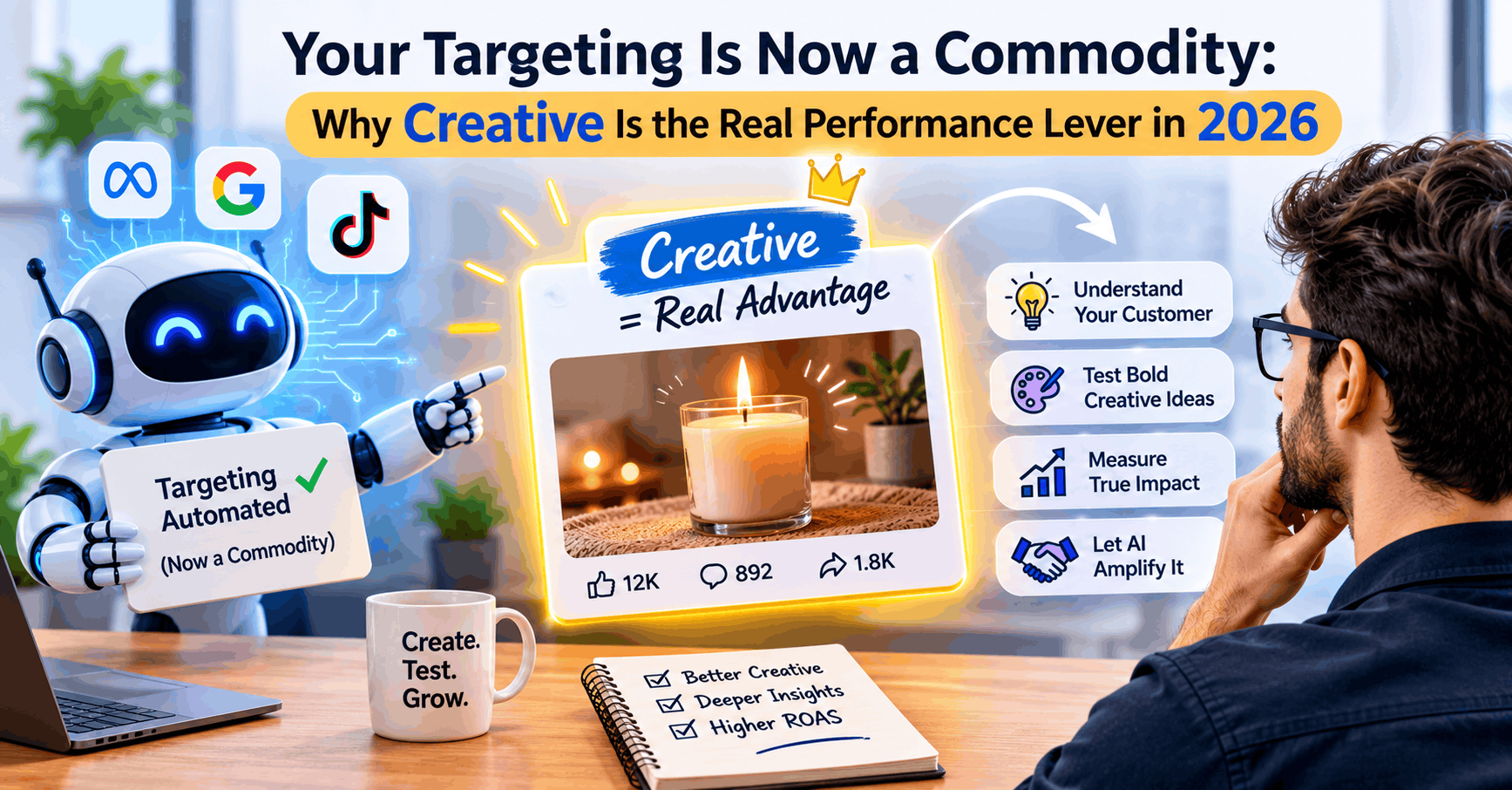
That moment is the heart of the most important shift in performance marketing right now. The platforms have automated the targeting. What’s left, the one lever that still belongs to you, is the creative.
The quiet takeover of the buying seat
Think about how campaigns were run not long ago. You chose the audience, set the bids, picked the placements, and tweaked everything by hand. Skill meant knowing which levers to pull.
Now look at how the major ad platforms work today. Meta’s Advantage+ campaigns, Google’s Performance Max and its AI-driven search formats, and TikTok’s automated solutions all push in the same direction. You hand over a budget, a goal, and a pile of assets. The machine decides who sees what, where, and when.
Whether you love this or hate it, it’s the reality. And it changes what “being good at performance marketing” means.
When everyone has access to the same algorithm, the same lookalike logic, and the same bidding intelligence, those things stop being an advantage. They become table stakes. Your competitor in the same category, with the same budget, is feeding the same machine. The only thing that differs is what you put into it.
Why “just make more ads” is the wrong lesson
When marketers first sense this shift, the instinct is to produce more creative. More variations, more hooks, more formats. Volume becomes the strategy.
I understand the logic, because algorithms do need fresh inputs. But volume without insight is just expensive noise. I’ve watched teams crank out forty versions of an ad that all say the same forgettable thing in slightly different fonts. The algorithm tests them dutifully, finds that none of them work, and the team concludes that “the platform is broken.”
The platform isn’t broken. The idea was weak, and no amount of variation fixes a weak idea.
Real creative testing isn’t about changing the button color. It’s about testing genuinely different angles: different reasons someone might buy, different fears they might have, different moments in their life. One ad might lead with price, another with status, another with relief from a specific frustration. Those are different messages, and they teach you something about your customer.
A story about a candle brand
Let me share a composite example, built from patterns I’ve seen across several small brands rather than one specific client.
Imagine a founder, call her Priya, who sells hand-poured soy candles online. Her ads showed beautiful product photos: warm light, soft focus, a cozy living room. They were pretty, and they performed fine. Not great, just fine. Her cost to acquire a customer kept creeping up.
Her team did what most teams do and tried new backgrounds, new color palettes, and a few seasonal variations. Nothing moved.
Then a customer service message changed everything. A buyer had written: “I light this every night after my kids fall asleep. It’s the only ten minutes of the day that’s mine.”
That sentence wasn’t about soy wax or fragrance notes. It was about reclaiming a small piece of a chaotic day. Priya’s team shot a simple, slightly imperfect video: a tired parent, a quiet kitchen, a match being struck. The caption was almost the customer’s exact words.
The ad didn’t look as polished as the old ones. But it spoke to a feeling, and the algorithm found the people who shared it. Performance improved, not because of a clever targeting trick, but because the message finally matched a real human moment.
That’s the pattern. The machine is brilliant at finding people. It cannot invent the reason those people should care.
The new job: becoming a customer translator
If targeting is automated, the marketer’s most valuable skill shifts from finding audiences to understanding them. That means doing things that feel unglamorous and very human.
Read your reviews, properly. Not for star ratings, but for language. Notice the exact words people use to describe their problem. Those phrases are better than any copywriter’s invention.
Talk to actual customers. Five conversations will teach you more than a month of dashboard staring. Ask what they were doing right before they bought, what almost stopped them, and what they told a friend.
Mine your support inbox. Complaints and questions are a gold mine of objections your ads should address before the customer even raises them.
Watch what people ignore. Sometimes the lesson is in the dead ads. If a message consistently flops, that’s information about what your audience doesn’t care about.
None of this shows up in an ad manager. But all of it ends up in the best-performing ads.
Measurement has to grow up too
Here’s the catch that doesn’t get enough attention. If creative drives performance, you need an honest way to tell which creative is actually working, and that’s harder than it sounds.
Platform-reported numbers tend to flatter the platform. Last-click attribution gives credit to whatever ad happened to be the final touch, even when an earlier video did the real persuading. With privacy changes limiting tracking, the picture has only become blurrier.
This is why many teams are leaning into incrementality testing: asking not “which ad got the click?” but “what would have happened if we hadn’t run this at all?” Holdout tests, geo experiments, and marketing mix modeling were once reserved for giant brands. Increasingly, smaller teams are using lighter versions of them.
You don’t need a data science department to start. Even a simple test, such as pausing a campaign in one region for two weeks and watching what happens to total sales, can reveal whether your “best performer” is truly creating demand or just taking credit for sales that were coming anyway.
Be ready for uncomfortable answers. Some campaigns that look like heroes turn out to be freeloaders. Finding that out is painful and also enormously valuable, because it frees budget for the work that really moves the needle.
What this means for how you work
Let me be practical. If you’re running performance marketing for a brand or a client, here’s how I’d rethink the week.
Spend less time in settings, more time in conversations. The settings matter less than they used to. The understanding matters more.
Brief creative like a strategist, not a vendor manager. Instead of “we need 10 new ads,” try “here are three customer motivations we haven’t tested, and here’s the evidence for each.” A good brief is half the performance.
Build a learning loop, not a production line. After each test, write down what the result taught you about the customer, not just which ad won. Over months, that notebook becomes your real competitive advantage.
Protect the human voice. Generative AI can now produce ad variations in seconds, and it’s a useful assistant for drafts, resizing, and iteration. But when every brand uses the same tools with the same prompts, everything starts to sound the same. The ads that cut through will carry something a model can’t fake: a specific observation, a real customer’s words, an honest bit of personality.
A word of reassurance
If all this sounds like the ground is shifting under your feet, you’re right, and it is a little unsettling. Many skilled people built careers on mastering the manual levers, and watching them get automated can feel like losing your craft.
But I’d gently suggest looking at it differently. The tedious, mechanical parts of the job are going away. What remains is the part that was always the most interesting: understanding why people do what they do, and finding the words and images that make them feel seen.
That was never something a bidding algorithm could do. It’s why the best marketers I know have always been curious about people first and platforms second.
The takeaway
Performance marketing in 2026 isn’t really a contest of who has the smartest targeting anymore. The machines have leveled that field. It’s a contest of who understands their customer most deeply and can express that understanding clearly enough, and quickly enough, for the algorithm to amplify.
So the next time you’re tempted to build a 47-segment audience spreadsheet, try something different. Close it. Open your reviews instead, find one sentence that makes you pause, and ask yourself: what would an ad built around this feeling look like?
Start there. The algorithm will take care of the rest.