




What Are Google Ads Keyword Match Types?
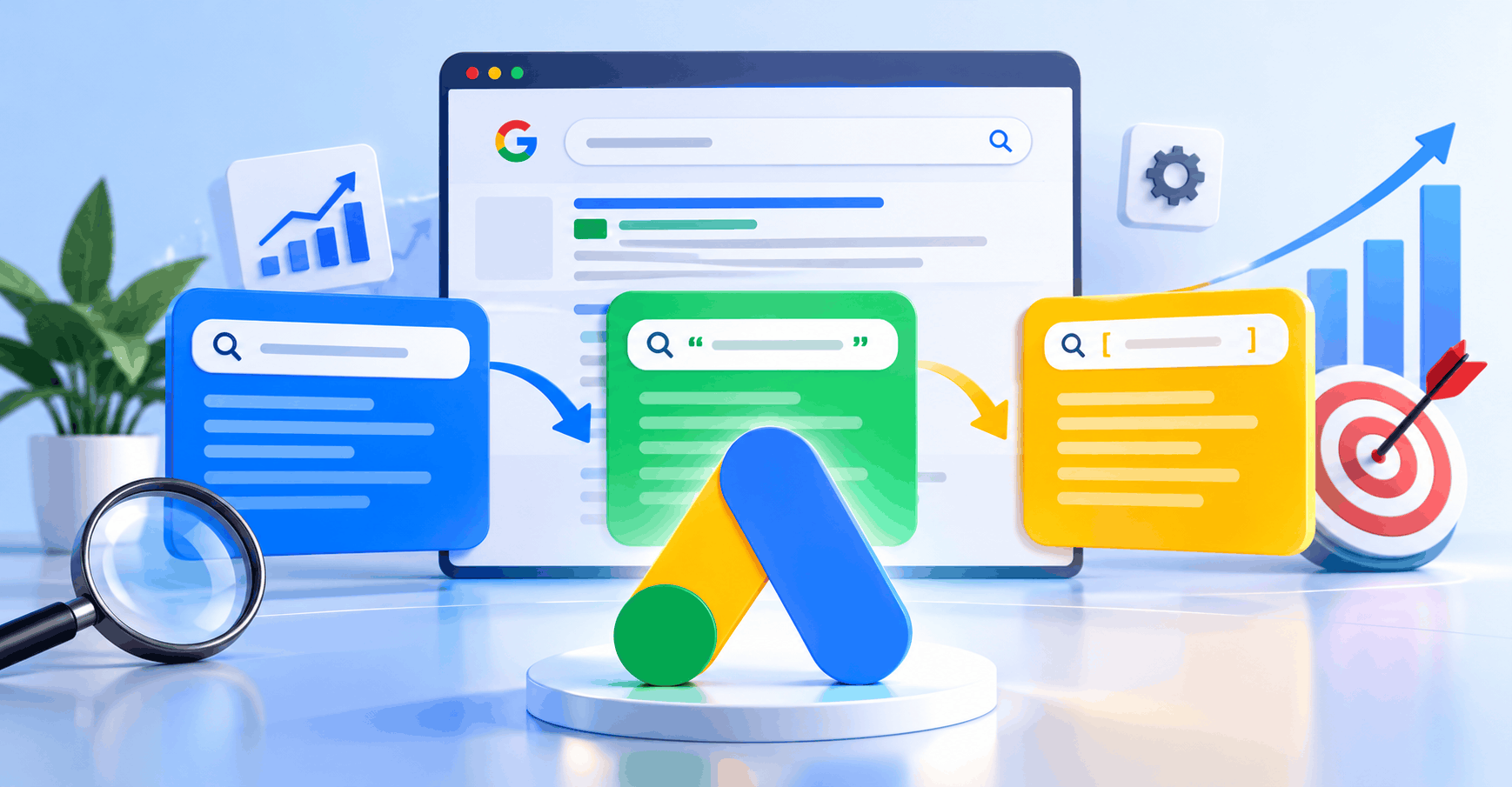
Every Google Search campaign starts with keywords — but those keywords only perform as intended when paired with the right match type. Google Ads keyword match types are settings that control how closely a user’s search query must align with your keyword before your ad becomes eligible to appear in the auction.
Choose too broad a match type and your ads appear for searches with no relationship to your product. Choose too narrow and your ads barely reach anyone. In 2026, getting this balance right matters more than ever: Google’s AI-powered matching has grown increasingly intent-driven, AI Max for Search campaigns has changed how advertisers expand reach, and the relationship between Smart Bidding and PPC keyword match types is now central to Search campaign performance.
Broad Match vs. Phrase Match vs. Exact Match: Key Differences
Google Ads currently offers three match types. Each one controls a different balance of reach and targeting precision.
Google Ads Broad Match: Reach More Relevant Searches
Google Ads broad match is the default. Add a keyword without any special formatting and Google assigns it as a broad match automatically.
Syntax: No symbols required — running shoes
With broad matches, Google interprets “related” liberally. Beyond your keyword’s literal meaning, it may factor in the user’s recent search activity, your landing page content, and other keywords in the same ad group to determine relevance. This makes it the widest-reaching option — and the most unpredictable without the right safeguards.
According to Google’s official documentation, it is critical to use Smart Bidding with broad matches. Every query carries unique contextual signals, and Smart Bidding uses these to ensure you compete in the right auctions at the right bid for the right user. Broad match without automated bidding frequently bleed budgets on irrelevant clicks before you can catch them.
Broad match works best for established campaigns with solid conversion data, larger budgets, and B2C audiences. It is not suitable for new campaigns, tight budgets, or high-CPC B2B accounts where intent shifts sharply with small changes in query wording.
Google Ads Phrase Match: Balance Reach and Control
Phrase match sits between broad match and exact match. Your ad can appear when a search reflects the meaning of your keyword, even if the phrasing differs or contains additional words.
Syntax: Quotation marks — “running shoes”
Since Google retired the broad match modifier in 2021, phrase match absorbed many of its behaviours. Today, phrase match is meaningfully broader than it was: it can match synonyms, reordered words, and implied context. For “running shoes”, your ad could show for “best athletic footwear for women” but not for “shoe repair near me,” which carries a different intent entirely.
Phrase match is a reliable starting point for new campaigns that need volume without sacrificing too much relevance. It also suits B2B campaigns where audience precision matters but some query variation is acceptable.
Google Ads Exact Match: Target High-Intent Searches
Exact match gives you the greatest control. Your ad appears only when a search carries the same meaning or intent as your keyword.
Syntax: Square brackets — [running shoes]
Exact match does not mean a character-for-character match. Google allows close variants including misspellings, singular and plural forms, function word removal, word reordering, and abbreviations. For [running shoes], your ad can appear for “run shoes” or “shoes for running” — but not for “best running shoes for beginners,” where the additional modifier changes the query’s specificity.
Exact match suits high-value keywords with proven conversion histories, branded terms, and accounts where every click needs to justify its cost.
Broad Match vs. Phrase Match vs. Exact Match Comparison
| Match Type | Keyword Syntax | Reach | Level of Control | Best Use Case |
| Broad Match | No symbols — running shoes | Widest | Lowest | Scaling campaigns with conversion data and Smart Bidding |
| Phrase Match | Quotation marks — “running shoes” | Medium | Medium | New campaigns, varied product searches, B2B with acceptable variation |
| Exact Match | Square brackets — [running shoes] | Narrowest | Highest | Branded keywords, high-value terms, limited budgets |
Google Ads Match Type Updates 2026: Close Variants, AI Max and Smart Bidding
Exact Match Close Variants 2026: What Has Changed?
Close variants have been expanding for years. In 2026, Google’s intent-based matching means exact match keywords surface queries with the same meaning but different word structure. Misspellings, plural forms, function word removal, word reordering, and abbreviations all fall within scope. Campaigns relying on keyword granularity to block unintended queries now need strong negative keyword lists to maintain targeting precision.
AI Max Broad Match Integration and Search Term Matching
AI Max for Search campaigns, launched by Google in May 2025, is not a keyword match type. It is a campaign-level optimisation suite — a toggle you activate within existing Search campaigns. When enabled, AI Max activates search term matching (which uses broad match and keywordless technology to expand beyond your keyword list) and asset optimisation (text customisation and final URL expansion).
The keywordless component surfaces queries based on your landing page content and ad assets, similar in concept to Dynamic Search Ads integrated into a Search campaign.
A significant 2026 development: starting in September 2026, Google began automatically upgrading campaigns that had the campaign-level broad match setting enabled to AI Max. If your Search campaigns were running that setting, this transition may already have affected your targeting behaviour. Review your Google Ads Auction Insights report to understand how this upgrade has affected your impression share, Ad Rank, and competitive position against rivals in the auction.
AI Max includes controls for brand inclusions and exclusions, URL settings, and geographic intent — but it operates at a layer above standard match types. Advertisers who need clear, readable attribution and clean Search Terms Reports should evaluate AI Max carefully rather than treating it as a routine upgrade.
Smart Bidding and Keyword Match Types
Smart Bidding — which includes Target CPA, Target ROAS, Maximise Conversions, and Maximise Conversion Value — sets bids at auction time using contextual signals like device, location, time of day, and prior search behaviour. As of June 2026, Google updated bidding strategy labels: “Maximise conversions with a Target CPA” is now simply “Target CPA,” and “Maximise conversion value with a Target ROAS” is now “Target ROAS.” The underlying bidding logic is unchanged.
Broad match pairs particularly well with Smart Bidding because a wider query pool gives the algorithm more data to identify which auctions are genuinely worth entering. Google’s guidance is unambiguous on this point: use Smart Bidding whenever you use broad matches.
Best Keyword Match Type Strategy 2026: Which One Should You Choose?
Scaling Google Ads with Broad Match
Broad match is appropriate for campaigns with established conversion histories, Smart Bidding active, and capacity for weekly monitoring. For B2C campaigns at scale, it can meaningfully expand reach into queries your original keyword list never anticipated. The essential discipline is reviewing the Google Ads Search Terms Report weekly to identify irrelevant queries and add them as negatives before they accumulate into significant wasted spend.
For new campaigns or accounts with fewer than 30–50 monthly conversions, broad match gives Smart Bidding too little signal to work effectively.
When to Use Phrase Match Over Exact Match
Choose phrase matches when your audience searches with consistent intent but varied phrasing. A service-based business targeting “accounting software for small businesses” will naturally attract searches phrased differently — phrase match captures this variation while filtering clearly unrelated queries. Exact match is preferable when intent shifts sharply with even small changes in wording, or when a specific keyword has demonstrated strong conversion performance you want to protect.
Phrase Match vs. Exact Match for Ecommerce
In ecommerce, the distinction sharpens at the product level. Phrase match for “leather boots” can capture “affordable leather ankle boots” and “women’s leather boots online” — mid-funnel purchase queries with high commercial value. Exact match for [leather boots] narrows to near-identical intent searches, delivering lower volume but stronger purchase signals.
A practical ecommerce approach: use phrase match to discover which specific product queries convert, then promote top performers to exact match to bid more aggressively on proven intent.
How to Transition from Phrase Match to Broad Match
Use Google’s campaign experiment feature to test a broad match version of key phrase match keywords alongside your existing campaign. Monitor CPA, ROAS, and search term relevance over 30–60 days before making a full switch. Build your negative keyword list from phrase match data first, so that broad match begins with guardrails already in place rather than learning from scratch.
Intent-Based Ad Groups 2026: SKAGs vs. Intent-Based Ad Groups
Are Single Keyword Ad Groups Dead in 2026?
Single Keyword Ad Groups (SKAGs) were designed for a world where exact match meant exactly one thing. Today, with close variants and meaning-based matching, the strict control SKAGs once provided has significantly diminished. Maintaining hundreds of single-keyword ad groups creates management complexity without delivering proportional targeting benefits.
That said, SKAGs are not universally obsolete. For branded campaigns, isolated high-value product terms, or keywords with enough volume to justify dedicated ad copy and landing page testing, isolated structures still make sense.
For most accounts, intent-based ad groups — grouping 5–10 semantically related keywords around a shared user need, product, or service — are more practical. This structure gives ad testing sufficient data, aligns naturally with how Google’s AI interprets keyword meaning, and simplifies account maintenance over time. Combining this approach with well-configured Google Ads location targeting adds a geographic precision layer that match types alone cannot provide.
Negative Keyword Match Types Explained 2026
Negative keywords tell Google when not to show your ads. They are essential for every campaign, but especially for broad and phrase matches where query expansion is widest. Importantly, negative keyword match types behave differently from positive match types.
Negative broad match blocks any search containing all the words in your negative keyword, in any order. Negative keyword: men’s jeans — your ad will not show for “cheap men’s jeans” or “men’s jeans blue,” but will still appear for “blue jeans” or “men’s trousers.”
Negative phrase match blocks searches containing your negative keyword in that exact word order. Negative keyword: “men’s jeans” — this blocks “cheap men’s jeans” but not “jeans men’s.”
Negative exact match only blocks the precise query. Negative keyword: [men’s jeans] — this blocks only the query “men’s jeans” and nothing else.
A practical example: a premium catering company might add “cheap,” “free,” “DIY,” and “recipe” as negative broad match keywords to prevent ads from appearing for budget or informational searches that will never convert into bookings.
Practical Tips to Optimise Google Ads Keyword Match Types
- Start with keywords that reflect actual customer intent — build your list around how your customers search, not internal product terminology.
- Select match types based on campaign maturity and conversion data — phrase or exact match for new campaigns; broad match with Smart Bidding once conversion history is established.
- Ensure Smart Bidding is active before using broad match — and confirm conversion tracking is accurate before relying on it for algorithmic bidding.
- Review the Search Terms Report weekly for broad and phrase match campaigns — identify irrelevant queries early and add them as negative keywords.
- Add exact match versions of your highest-converting keywords — regardless of campaign structure, isolating proven performers in exact match protects performance gains.
- Evaluate CPA, ROAS, and search term relevance before expanding targeting — scale only when your current match type setup is delivering consistent, efficient results.
Conclusion: Building a Smarter Google Ads Match Type Strategy
Google Ads keyword match types in 2026 are governed more by search intent than by keyword syntax. Exact match captures close variants, phrase match covers a broader territory than it once did, and broad match — when paired with Smart Bidding — can find genuinely relevant queries that no keyword list would anticipate on its own.
The strongest match type strategy is not built around a single choice. It is built around selecting the right match type for each campaign’s stage, monitoring search term data consistently, and using negative keywords to keep targeting honest as Google’s AI expands its interpretation of what “related” means.