




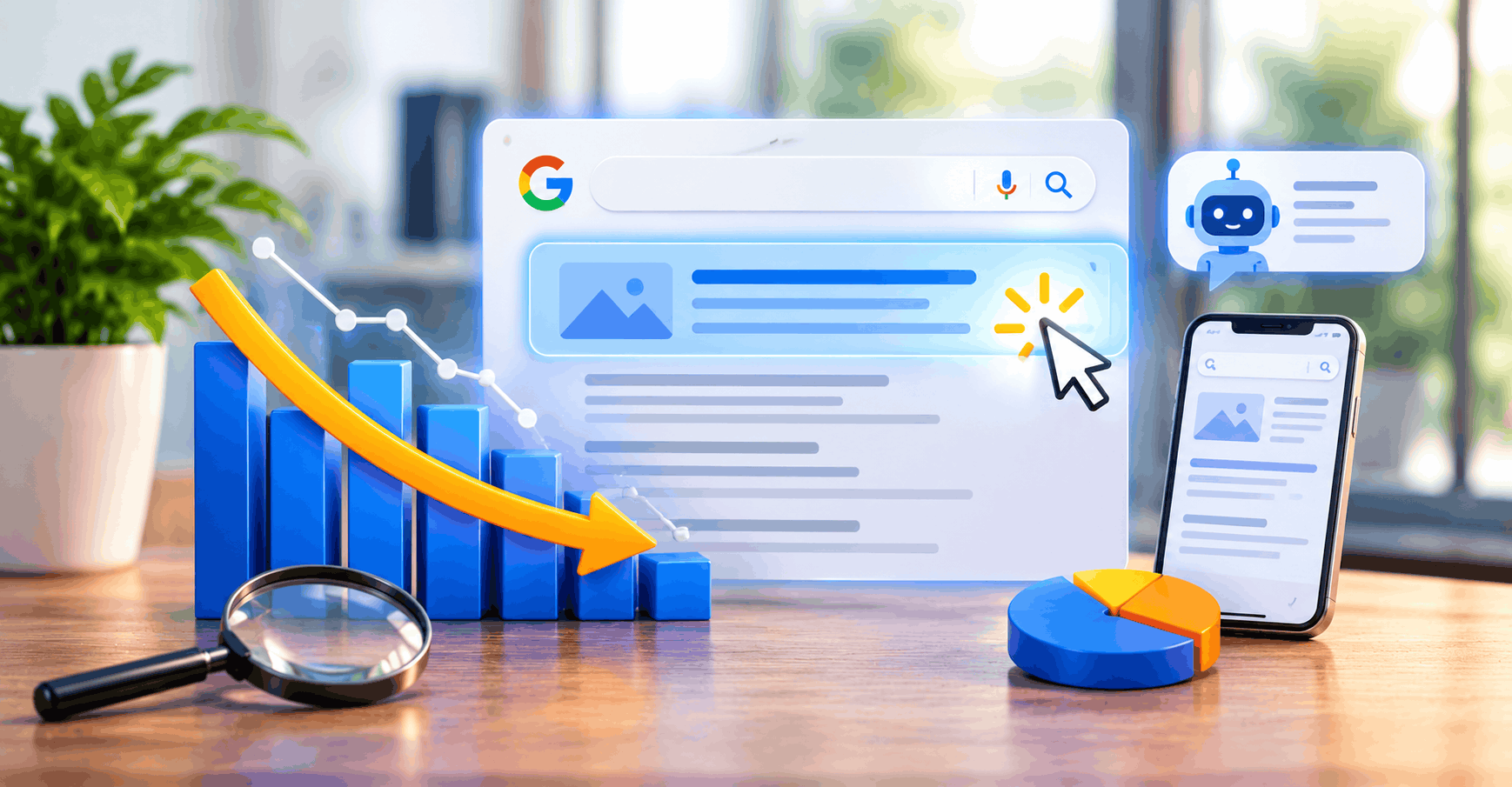
You’ve made it to page one. You’re getting impressions. Your rankings look steady. Yet, somehow, your organic clicks keep dropping. If this sounds familiar, you’re seeing the fallout from zero-click search—where users find exactly what they’re after right on the results page and never bother to visit your site.
This trend isn’t exactly new, but it’s suddenly everywhere. Google’s AI Overviews, enhanced search features, and AI assistants like ChatGPT, Gemini, and Perplexity are all speeding things up.
Let’s break down what’s driving zero-click search, what the latest data actually shows, and—more importantly—how you can keep traffic and conversions coming, even when a click is far from guaranteed.
What’s a Zero-Click Search, Anyway?
Zero-click happens when Google (or any search engine) answers a user’s question directly, so nobody visits a website. These answers take lots of forms:
- AI Overview or summary right at the top
- Featured snippets or “People Also Ask” boxes
- Knowledge panels (things like weather, scores, definitions)
- Maps and local packs showing hours, directions, phone numbers
- Shopping carousels, video results, rich snippets—all the extras
Sometimes, users are content and just stop. Sometimes, they refine their search, but still never leave Google. Either way, your website doesn’t get a visit.
What the Data Really Shows
Most U.S. searches now end without a click. SparkToro, pulling Similarweb panel data from January to April 2026, estimates about 68% of Google searches finish on the results page—no one clicks out. Search Engine Land says even fewer queries are getting clicked now, with about a 9.5 percentage point drop since 2024.
AI Overviews make it worse. In SparkToro’s report, when AI Overviews showed up, zero-click jumped from 54% to 72%, and organic clicks dropped roughly 38%. They think this trend is strongly tied to AI Overviews, though they can’t fully separate cause and effect.
Pew Research Center checked real browsing habits in 2025. U.S. adults were half as likely to click a standard link if an AI summary appeared. Links inside those summaries? Almost never clicked—think 1% of visits.
Ahrefs looked at 300,000 keywords in late 2025 and found top results hit by AI Overviews saw their click-through rates tank—down 58%. Earlier numbers were closer to 34.5%.
AI Mode (the interactive stuff) is still tiny, but watch out. SparkToro found only 0.34% of searches went into Google’s AI Mode in their study, so it’s not a huge factor yet. If usage picks up, expect bigger impacts.
Citations help, but they don’t restore clicks. Seer Interactive showed queries without AI Overviews managed a 3.3% organic CTR, while pages cited inside the Overview landed at 2.1%. Those not cited barely reached 0.9%. At least citation helps a little: CTR on AI Overview queries recovered from 1.3% in December 2025 to 2.4% by February 2026.
A Few Caveats
- Methods vary—a panel here, Search Console there, real user data somewhere else. Numbers won’t match up.
- SparkToro’s 2024 and 2026 data came from different panels. Some of the jump might just be how things were measured.
- Most of this is U.S. data. Places like India, with mobile dominance and local search quirks, could see things play out differently. Check your own metrics.
- Zero-click isn’t always zero impact. People might see your brand, search again, or buy later—even if they don’t click.
- Google says traffic losses aren’t as dramatic as they look; links inside AI stuff drive quality clicks.
Why Zero-Click Search Keeps Growing
1. AI Overviews answer everything upfront.
AI pulls info from tons of sources and bundles it right at the top. For lots of questions, problems are solved—no need to click.
2. Google’s been doing this for ages.
Featured snippets, panels, “People Also Ask,” maps, shopping results—they all keep users on Google. AI summaries are just the latest, most powerful step.
3. Mobile users want quick wins.
On a phone, loading a website is slow. Instant answers or call buttons are faster, especially for “near me” searches or simple facts.
4. People are comfy with chat-style search.
Long, complex asks are normal. Tools like ChatGPT, Gemini, Perplexity encourage direct Q&A—less clicking, more chatting.
5. Searches start in other places now.
Discovery happens on YouTube, Reddit, Insta, marketplaces, and AI bots. Stuff that used to mean a Google click might never hit Google anymore.
6. Brand familiarity equals fewer clicks.
If users already know you, they’ll grab what they need right from the results—contact info, prices, reviews—or go straight to your site.
7. Easy-to-digest content gets summarized.
A lot of pages are simple lists, definitions, or step-by-step guides—the sort of thing AI can summarize in seconds. When the answer’s easy, people don’t click.
How To Spot Zero-Click Pain
Check Search Console for these:
- Impressions steady or rising, but clicks dropping
- Average ranking hasn’t budged
- Drop-offs focused on informational queries
- Big declines where AI Overviews now show up
- Branded impressions rise (your presence is landing, just not clicks)
If this matches what you see, it’s likely the SERP features—not your SEO—at fault. Don’t overhaul your content (yet).
Ways to Actually Drive Traffic and Conversions
1. Look beyond clicks.
Clicks are fading as a measuring stick. Add these to your dashboard:
- Search impressions and visibility
- Branded search volume, direct traffic
- Citations in AI summaries, brand mentions
- Assisted conversions, lead quality
- Self-reported attribution (“How did you hear about us?”)
2. Chase citations, not just rankings.
Getting named in an AI Overview beats being invisible. To boost your odds:
- Use answer-first content. Start with the clear answer and go deeper below.
- Make headings, lists, tables, and paragraphs concise and scannable.
- Add schema markup where it fits.
- Source credible info, stay accurate, update often.
- Show expertise and authority—named authors, credentials, transparent sources.
3. Give users a reason to click.
Lots of queries get answered by summaries—but not everything. Stand out by offering stuff AI can’t:
- Original research, data, surveys
- Tools and calculators
- Templates and ready-to-download resources
- In-depth comparisons and buying guides
- Honest reviews, case studies, expert hot-takes
- Opinion with clear voice
Summaries answer “what.” Your page should help users do something.
4. Target high-intent, transactional queries.
AI snags informational queries. Commercial, local, and transactional searches still rely on clicks. Make these your priority:
- Product/service pages
- Comparison and “best for” pages
- Pricing, demo, inquiry pages
- Local landing pages
5. Own the features you can’t dodge.
If Google shows answers anyway, make sure it’s your answer.
- Optimize for featured snippets and People Also Ask
- Update your Google Business Profile (photos, details, hours, Q&A, posts)
- Encourage and respond to reviews
- Use schema for products, reviews, organizations
- Write compelling titles and meta descriptions
6. Build brand demand outside Google.
Strong brands get searched by name. Branded searches convert best. Grow demand with:
- Email newsletters, communities
- YouTube and video
- LinkedIn, Instagram, Whatsapp (especially in India)
- Podcasts, webinars, events
- Digital PR, expert guest posts
- Forums like Reddit, Quora
Be that brand people recognize before they even search.
7. Own your audience.
Zero-click makes owned channels precious. Use content upgrades, gated resources, newsletters, app notifications, WhatsApp opt-ins—anything to convert visits to loyal contacts, not just fleeting clicks.
8. Boost conversions on actual traffic.
Every click means more. Sharpen:
- Page speed, mobile experience
- Clear value proposition and CTAs
- Smooth forms and checkout
- Trust signals (reviews, certifications, case studies)
- Internal links guiding users further
Even a small bump in conversions can offset a drop in traffic.
9. Go local, go regional.
Indian brands, in particular—local SEO and native language content help where AI has blind spots, and user intent is high. Google Business Profile, local pages, regional-language content can reach new audiences.
10. Leverage rich result formats.
Clean headings, transcripts for videos, FAQs, step-by-step lists, optimized images. These formats can put you in carousels, video/image results, not just standard links.
11. Don’t rely solely on Google.
Google dominates, but you can’t depend on it alone. Build presence on Bing, YouTube, marketplaces, social search, AI chat platforms—wherever your audience looks.
12. Track and test—always.
Search features and AI change fast. Watch Search Console, run monthly tests in AI tools, test tweaks on small batches of pages before rolling out big changes.
Which Content Gets Hit, Which Survives
Most exposed to zero-click: simple definitions, basic how-tos, weather/scores/conversions, generic explainers, pure informational queries.
More resilient: original data/research, calculators/tools/templates, detailed comparisons, expert opinion, local/branded/transactional queries.
Quick Action Plan
- Audit: Flag pages in Search Console with drops in clicks but steady impressions.
- Segment: Sort by query intent—informational, commercial, local, transactional.
- Restructure: Add answer-first content, FAQs, schema to priority pages.
- Differentiate: Add research, tools, templates, expert/unique input.
- Shift focus: Invest in high-intent pages, local presence, brand-building channels.
- Capture: Push newsletter signups, WhatsApp groups, lead magnets.
- Remeasure: Track citations, branded search, assisted conversions, lead quality quarterly.
Avoid These Mistakes
- Don’t panic and give up on SEO. Rankings still matter, and feed AI summaries.
- Don’t blame rankings first—check if SERP features explain the drop.
- Don’t crank out more basic content. Thin pages are exactly what AI will summarize away.
- Don’t measure only clicks—you’ll miss influence that happens without a visit.
- Don’t ignore non-Google platforms. Audiences are splitting up.
- Don’t blindly trust U.S. data for other markets. Check your own numbers.
- Don’t start hiding content in hopes of forcing clicks—restricting search visibility usually backfires.
A Word on Evidence
Zero-click stats differ wildly depending on how they’re measured and what’s counted. Most studies are U.S.-focused, using SparkToro, Pew, Ahrefs, Seer Interactive data. Treat these numbers as rough guides—not gospel. Always check the original sources and lean on your own analytics.
The Bottom Line
Zero-click search keeps rising because Google (and now AI assistants) answer questions immediately. This shifts the old model—”rank high, get clicks”—especially for informational queries.
Traffic and conversions aren’t dead yet. Marketers who adapt will measure more than clicks, chase citations in AI answers, build content people actually want to see, focus on high-intent/local searches, and keep brand loyalty strong.
In a zero-click world, the winners aren’t just the highest-ranked pages. They’re the brands people remember, search for by name, and choose—whether or not they click.