





Think about the last ad that made you stop scrolling. Maybe it made you laugh. Maybe it showed up at exactly the moment you needed it, and for a second it felt almost kind. Now think about the last ad that made you roll your eyes: the one for a mattress you already bought, or a product you looked at once and have been chased by ever since.
Both of those ads were probably touched by algorithms. The difference between them is the story of where advertising is heading. For decades, ads were something brands did to us. With AI, they are slowly becoming something that happens with us, and that shift is bigger than most people realise.
The old way: shouting into a crowd
Traditional advertising worked like a megaphone. A brand picked a billboard, a TV slot or a newspaper page, wrote one message and hoped the right people would notice. Success was measured in reach: how many eyes passed by. Whether those eyes cared was mostly guesswork.
Even early digital ads weren’t much smarter. They simply followed us around. Browse a pair of shoes and for the next two weeks every website you visit insists you still want them. It was targeting, but it wasn’t understanding. It treated people like a list of clicks instead of humans with moods, budgets, habits and bad days.
AI is changing that, not because it makes ads louder, but because it makes them better at noticing.
From shouting to noticing
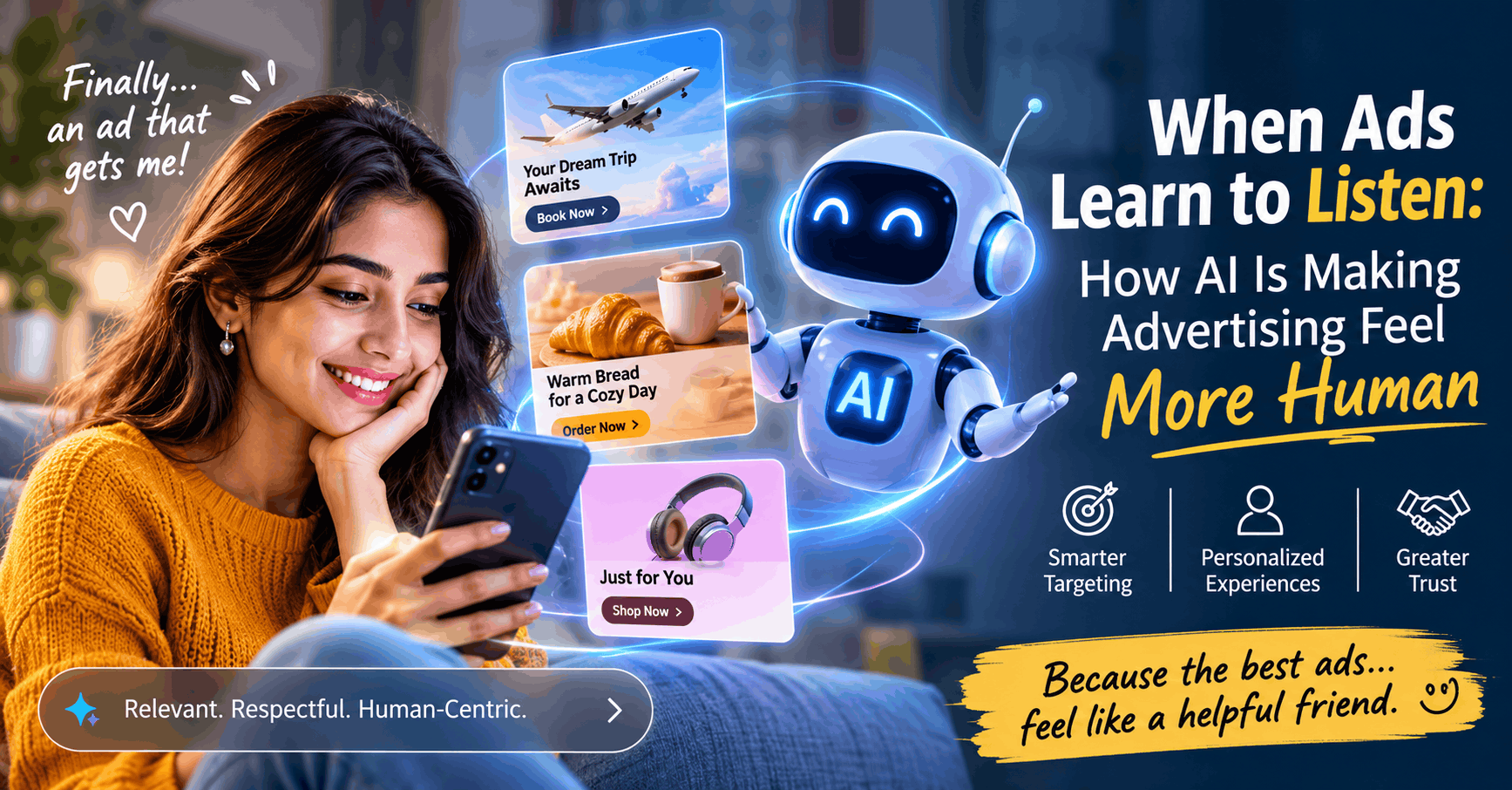
Modern AI systems can process patterns no human team could ever track: what time of day someone is likely to be receptive, what kind of language they respond to, whether they prefer a short punchy message or a longer story. Used well, this means the ad you see is less random and more relevant.
Here is a simple example. A local bakery used to run one flyer for everybody. Today, an AI-assisted tool can help that same bakery send a rainy-day message about warm bread to people nearby on a gloomy Tuesday morning, and a festival-season message about gift boxes closer to the holidays. Nobody is being tricked. The bakery is just speaking at the right moment, in the right tone.
That is the promise: fewer irrelevant ads, and more that feel like useful suggestions from someone who actually paid attention.
Creativity gets a co-writer
One of the biggest changes is happening behind the scenes, in how ads get made. Generative AI can now draft slogans, suggest visuals, produce a dozen versions of a video and translate a campaign into several languages in an afternoon. For a small business with no agency and no budget, that is huge. A shop owner who once couldn’t afford a designer can now test ideas, adjust them and publish something polished.
This doesn’t mean creativity is dying. If anything, it moves the bottleneck. When anyone can generate a hundred ad variations in minutes, the scarce thing is no longer production. It is taste. The people who thrive will be the ones who know which idea is genuinely good, which joke lands, which message sounds like a real person and not a template.
The best creative teams already work this way. They let AI handle the repetitive heavy lifting (resizing, drafting, testing) so humans can spend their energy on the spark: the insight about what people truly feel, want or fear.
Conversations replace campaigns
Another quiet shift is that advertising is becoming interactive. Instead of a one-way message, brands can now answer questions in real time. Imagine seeing an ad for a laptop and being able to ask it, in plain language, whether it’s good for video editing on a budget, and getting a clear, honest reply.
Chatbots, voice assistants and recommendation engines are turning the old “campaign” into an ongoing conversation. The ad isn’t the end of the message anymore. It is the start of a dialogue. When this is done well, shopping feels less like being sold to and more like asking a knowledgeable friend for advice.
When it is done badly, of course, it feels like a pushy salesperson who never lets you leave the shop. The technology can’t decide which of those you get. The people designing it do.
The trust problem nobody can skip
Here is the honest part of the story. The same tools that can make ads more helpful can also make them more invasive, and people can feel the difference.
A few real concerns deserve attention:
- Privacy. Personalisation runs on data. The more an ad seems to know about you, the more it can feel like being watched. There is a line between “relevant” and “creepy,” and it sits in a different place for everyone.
- Manipulation. An AI that learns exactly when you are tired, lonely or stressed could nudge you into buying things you don’t need. Persuasion becomes ethically murky when it targets vulnerability.
- Authenticity. As AI-generated images, voices and even “customer reviews” become easier to produce, people will struggle to know what is real. Fake testimonials and synthetic influencers can erode trust fast.
- Sameness. If every brand uses the same tools trained on the same data, ads risk all sounding polished, friendly and identical.
Brands that ignore these worries will pay for it. Audiences are getting sharper, and regulators around the world are paying closer attention to data use and disclosure. In the long run, trust is the only thing that makes advertising work at all. Clicks can be bought, but belief cannot.
The smartest companies are already responding by being transparent about how they use data, giving people real control over what they see, and clearly labelling AI-generated content. That honesty is becoming a competitive advantage, not just a legal requirement.
What stays human
It is tempting to imagine a future where machines write, design, place and optimise every ad with no people involved. But that picture misses what makes advertising memorable in the first place.
The ads we remember rarely stick because of perfect targeting. They stick because they made us feel something: a flash of nostalgia, a shared joke, a moment of recognition that said, someone gets me. That kind of emotional truth comes from lived experience, culture and empathy, and those are still deeply human territory.
AI is excellent at answering the question “what will this person probably respond to?” It is much weaker at the question “what is worth saying?” Deciding what a brand stands for, what it refuses to do, and how it should treat the people it speaks to is not a technical problem. It is a values problem.
What this means for you
If you work in marketing or run a small business, the practical takeaway is simple: use AI as a tool for listening, not just for louder broadcasting. Let it help you understand your customers better, test ideas faster and reach the right person at the right time. Then keep a real person in charge of tone, honesty and judgment.
If you are simply someone who scrolls, watches and shops, you have more power than you think. Pay attention to which brands respect your data and your intelligence, and reward them. The market tends to follow where trust goes.
A closing thought
Advertising has always been, at its core, a conversation between a business and the people it hopes to serve. For a long time that conversation was one-sided and loud. AI gives us a chance to make it more attentive, more useful and, if we are careful, more respectful.
The future of ads will not be decided by algorithms alone. It will be decided by the choices people make about how to use them: whether to exploit attention or earn it, whether to chase every click or build something worth coming back to.
The best version of that future is one where an ad doesn’t feel like an interruption. It feels like a helpful hand at the right moment. We are not there yet, but for the first time, the tools to get there are in our hands.