








Every advertiser eventually hits the same wall. A campaign delivers a healthy return at ₹2,000 a day, so you push it to ₹10,000 and watch the numbers sag. Costs climb, purchases slow down, and the profit you were celebrating disappears within a week.
Scaling on Meta has changed. The old habit of cloning ad sets and slicing audiences into narrow interest buckets now tends to hurt more than it helps. This guide explains what to do instead: how horizontal and vertical scaling work in 2026, when to use each, and which mistakes quietly drain your return on ad spend (ROAS).
Why Scaling Feels Harder Than It Used To
Meta’s delivery system has moved toward consolidation. With the Andromeda update, the platform leans heavily on creative signals to decide who sees your ad. Instead of you telling Meta who to reach, your creatives increasingly tell Meta who to reach.
That shift changes where the leverage sits. A few years ago, advertisers scaled by multiplying audiences. Today the leverage sits in three places:
- Creative variety: the range of hooks, formats and angles you feed the system.
- Conversion signal quality: how clean and frequent your purchase or lead data is.
- Account stability: how rarely you disturb a campaign that is already learning well.
If you treat scaling as a structural puzzle, you will fight the algorithm. If you treat it as a creative and data problem, you work with it.
What Scaling Actually Means
Scaling is not simply spending more. It means increasing spend while holding your ROAS or cost per acquisition (CPA) within a range that keeps the business profitable. Spending more and earning proportionally more is the goal; spending more and earning the same is just a bigger bill.
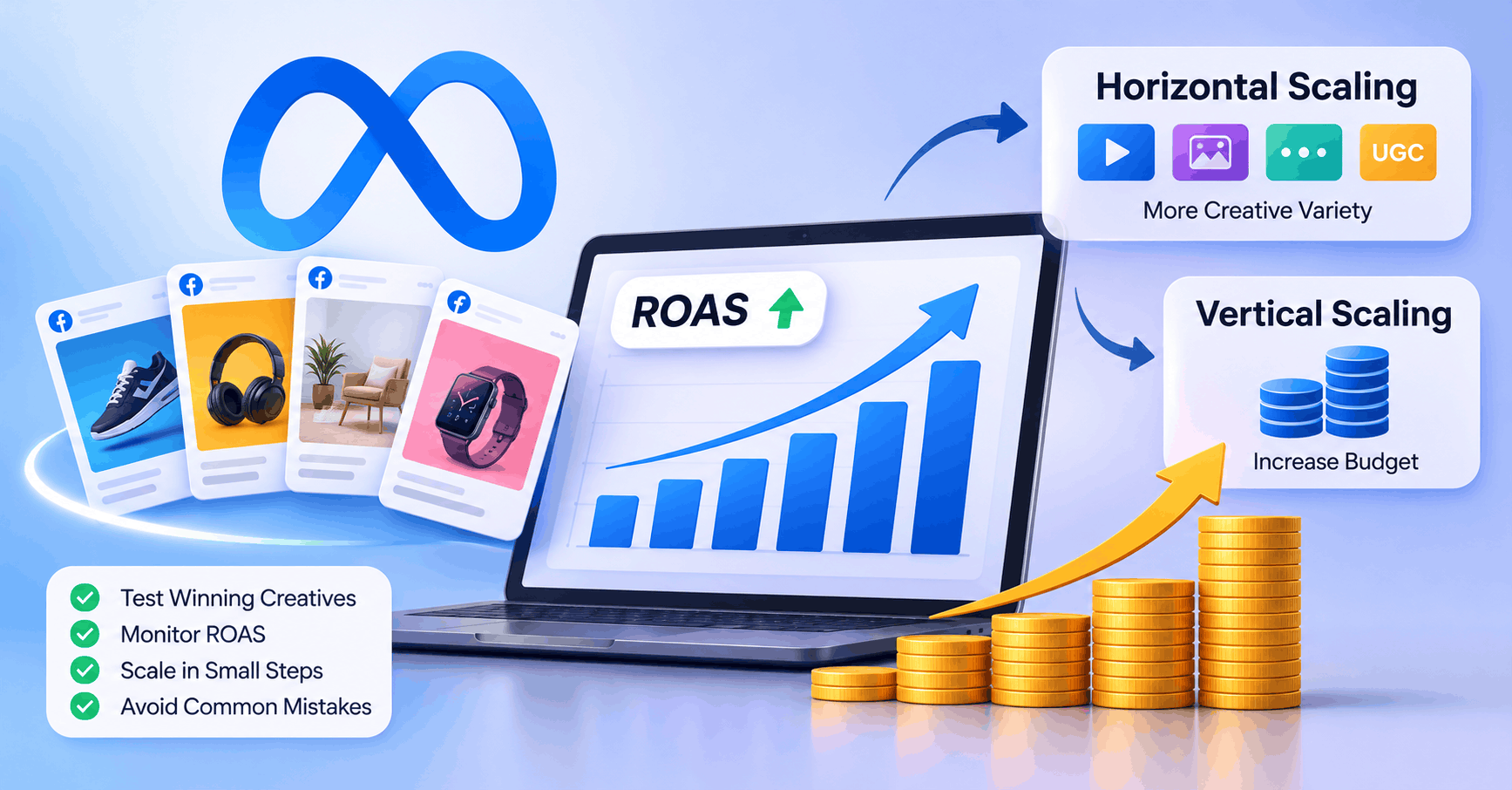
There are two ways to do it. Horizontal scaling widens what you are running. Vertical scaling deepens how much you put behind what already works. Strong accounts use both, in a deliberate order.
Step Zero: Confirm There Is Something Worth Scaling
Before you touch a budget, check the foundations. Scaling amplifies whatever is already there, including the flaws.
Here is a quick test. If you are getting plenty of clicks and a respectable click-through rate but almost no purchases, the problem is not reach. Meta is delivering traffic, but that traffic is not turning into customers. Pouring more money simply multiplies the loss.
Before scaling, make sure you have:
- Consistent conversions: purchases or leads arriving daily, not in occasional bursts.
- A stable CPA: a cost per result that holds steady across at least a week.
- A landing page that closes: fast load time, a clear offer, and a checkout or form with little friction.
- Healthy margins: enough room that a modest rise in acquisition cost will not push you into the red.
If any of these are shaky, fix them first. Scaling a leaky funnel is the most expensive way to learn that it leaks.
Horizontal Scaling: Widen the Creative Pipeline
In the past, horizontal scaling meant duplicating ad sets to test new audiences. In 2026 it mostly means expanding the creative inputs inside a consolidated structure.
What it looks like in practice
- Keep one or two stable ad sets rather than ten fragmented ones.
- Load each with several genuinely different creatives, not minor tweaks of the same image.
- Vary the hook in the first three seconds, the format (video, static, carousel, UGC) and the core message.
- Let Meta distribute spend toward whichever creative resonates with each pocket of the audience.
Why it works
Consolidation gives the algorithm more data per ad set, which speeds up learning and reduces overlap between your own campaigns. Diverse creatives, meanwhile, give the system more ways to find the right buyer. One message may land with price-sensitive shoppers, another with people who care about quality or convenience.
Make your variations real
The most common horizontal scaling error is testing the same idea in different colours. Meta treats near-identical creatives as one. Test different angles instead: a problem-led hook, a testimonial, a founder story, a comparison, a demonstration. Each one should be able to win or lose on its own.
Aim for a steady rhythm, such as three to five new creatives every couple of weeks, so there is always a fresh challenger waiting.
Vertical Scaling: Raise Budget Without Shocking the System
Vertical scaling is the straightforward part: you increase the budget on a campaign that is already profitable. The skill lies in doing it gently.
A safe budget approach
- Increase in small steps. A rise of roughly 10 to 20 percent every two to three days is a common, cautious rhythm.
- Scale winners only. Never raise money on a campaign that is merely “okay.”
- Watch CPA and ROAS, not just CPM. Cheaper impressions are encouraging, but they do not pay the bills. If CPM falls while purchases stay flat, you have cheaper reach, not better performance.
- Hold steady after each change. Give the campaign a few days to settle before judging the result or adding more.
Large jumps can unsettle delivery and push a campaign back into learning, which is when costs tend to spike. Slow and consistent beats fast and fragile.
When to pull back
If CPA rises well beyond your acceptable range for several days running, step the budget back down rather than pushing through. A temporary reduction protects the signal you have built far better than stubbornness does.
Horizontal vs Vertical Scaling at a Glance
| Horizontal scaling | Vertical scaling | |
| Core idea | Add more creative variety | Add more budget |
| Main lever | Hooks, formats, messaging | Daily or lifetime spend |
| Best for | Finding new buyers, fighting fatigue | Capturing proven demand |
| Key risk | Weak, repetitive variations | Resetting learning, rising CPA |
| Speed | Gradual, compounding | Fast, but must be paced |
The practical rule: horizontal scaling feeds vertical scaling. Fresh creatives create winners, and winners earn the right to a bigger budget.
Mistakes That Quietly Kill ROAS
1. Scaling before there is proof. Budget increases on unproven campaigns turn small inefficiencies into large ones.
2. Judging by vanity metrics. Click-through rate, CPC and CPM describe traffic. Revenue, CPA and ROAS describe business results. Decisions should rest on the second group.
3. Over-fragmenting the account. Many small ad sets split your data thin and slow learning. Consolidate where you can.
4. Editing too often. Constant tweaks to budgets, audiences and creatives keep the system off balance. Change one thing at a time, then wait.
5. Ignoring creative fatigue. Even a brilliant ad wears out. Rising frequency, falling click-through rate and climbing CPA are your early warning signs.
6. Neglecting the landing page. Scaling sends more people to the same page. If it converts poorly at low volume, it will convert poorly at high volume.
A Simple Rhythm for Your Next 30 Days
If you want a practical starting point, try this sequence:
- Week 1: Audit. Check conversion tracking, landing page speed and your current CPA baseline.
- Week 2: Build the creative bench. Launch three to five distinct creatives in a consolidated ad set and let them gather data.
- Week 3: Identify winners. Keep the creatives driving purchases at an acceptable CPA and retire the laggards.
- Week 4: Raise budget gradually. Apply small increases to the winning setup while tracking ROAS daily.
Then repeat. Each cycle feeds the next, so growth compounds instead of spiking and crashing.
Final Thoughts
Scaling Meta ads in 2026 is less about clever account architecture and more about discipline. Build strong, varied creatives. Protect your conversion signals. Increase spend patiently. Do those three things consistently and the algorithm has everything it needs to find more of your best customers.
When scaling stalls, the cause is rarely the budget itself. It is usually the offer, the creative or the conversion path, and each of those can be fixed.
FAQ
Raising budgets before the campaign has proven it can convert, and then judging results by CPM or CPC instead of revenue and ROAS.
When you see steady purchases, a stable CPA and a ROAS comfortably above your break-even point over a sustained period.
A gradual 10 to 20 percent increase every few days is a widely used, low-risk approach, as long as you monitor CPA and ROAS after each step.
Common causes include creative fatigue, audience saturation, and sudden budget jumps that disrupt delivery.
No. A lower CPM only means impressions cost less. Performance is decided by conversions and the cost of each one.
Use both. Add creative variety to find winners, then increase budget on those winners in controlled steps.