


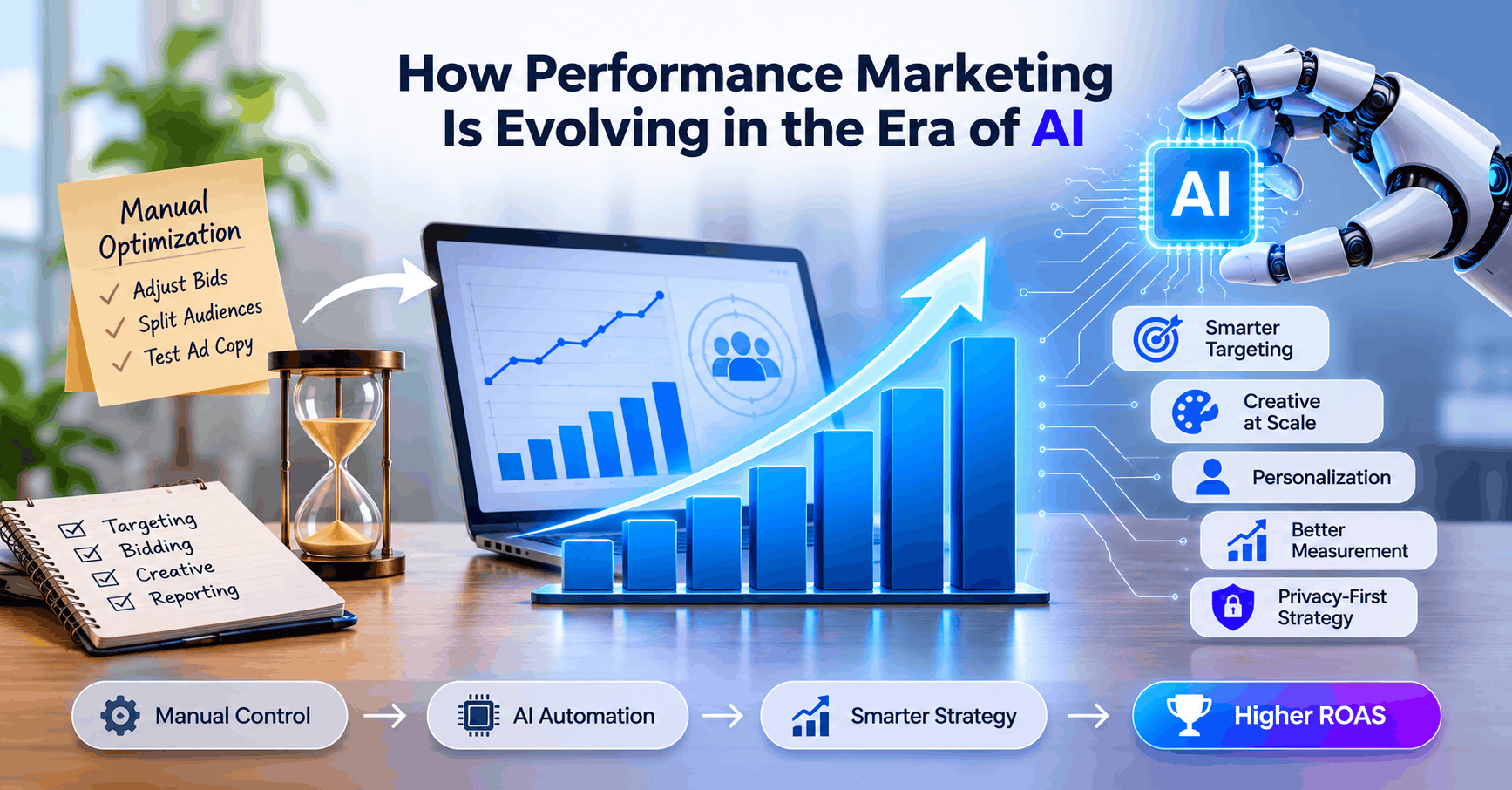
Performance marketing has always been about one promise: pay for results, not impressions. For years, that meant marketers spent their days adjusting bids, splitting audiences, and testing ad copy by hand. Today, artificial intelligence is taking over much of that manual work and changing what the job actually looks like. Here is how the shift is unfolding and what it means for brands and marketers.
From Manual Optimization to Machine-Led Decisions
A decade ago, a good performance marketer was someone who knew every lever in the ad platform. Keyword match types, bid adjustments by device, hour-of-day scheduling: all of it was controlled by hand.
Now the platforms do much of this themselves. Google’s Performance Max, Meta’s Advantage+ campaigns, and similar automated formats use machine learning to decide who sees an ad, where it appears, and how much to bid, in real time and across millions of signals. A human cannot process that volume of data at that speed. The marketer’s role is moving from operating the campaign to steering it: setting goals, feeding the system good data, and judging the results.
Smarter Targeting Through Predictive Models
Traditional targeting relied on demographics and interests. AI-driven targeting looks at behavior patterns and predicts intent. Predictive models can estimate which users are most likely to convert, which customers are likely to churn, and which will bring the highest lifetime value.
This changes the question from “Who is my audience?” to “Who is likely to act next, and what will they be worth?” Brands that optimize for customer lifetime value rather than a single cheap purchase are seeing stronger long-term returns.
Creative at Scale
Creative used to be the slowest part of performance marketing. Producing enough ad variations to test properly took weeks. Generative AI has collapsed that timeline. Teams can now produce dozens of headlines, images, and short videos in an afternoon, then let performance data show what resonates.
The risk is sameness. When everyone uses the same tools, ads start to look and sound alike. The winners will be brands that combine AI speed with a distinct voice, real customer insight, and human taste. AI can generate options, but deciding what is on-brand and genuinely persuasive remains a human strength.
Personalization That Feels Individual
AI makes it practical to tailor messages to individual users rather than broad segments. Dynamic creative can change the image, offer, or copy based on a person’s browsing history, location, or stage in the buying journey. Product recommendations, email send times, and retargeting sequences can all adapt automatically.
Done well, this feels helpful. Done poorly, it feels intrusive, which brings us to privacy.
Privacy, Data, and the End of Easy Tracking
The industry is moving away from third-party cookies and facing tighter privacy regulation and platform restrictions on tracking. At the same time, AI models are only as good as the data they learn from. This makes first-party data (information customers share directly with a brand) more valuable than ever.
AI is also helping fill measurement gaps. Modeled conversions, marketing mix modeling, and incrementality testing use statistical and machine learning methods to estimate impact when direct tracking is incomplete. Marketers who invest in clean, consented data and solid measurement will have a real advantage.
Search Is Changing Too
AI-generated answers and conversational assistants are changing how people find products. Instead of scanning ten blue links, users increasingly get a summarized answer or a recommendation. For performance marketers, this means rethinking search strategy: structured product data, strong reviews, and helpful content matter more, and new ad formats are emerging inside AI-driven search experiences. Brands need to be visible not only in search results but also in the answers AI systems give.
What Marketers Need to Do Differently
As automation grows, the skills that matter are shifting:
- Strategy over execution. Knowing which business goals to optimize for matters more than knowing which button to click.
- Data quality. Automated systems learn from the signals you give them. Poor conversion data leads to poor optimization.
- Creative thinking. With targeting and bidding increasingly automated, creative is one of the biggest levers left for marketers to pull.
- Experimentation and measurement. Running proper tests to separate real impact from platform-reported results is essential.
- Healthy skepticism. Automated platforms report their own success. Marketers should verify it independently.
The Challenges to Watch
AI brings real risks alongside its benefits. Black-box systems can make it hard to understand why a campaign performs the way it does. Over-reliance on automation can quietly waste budget. Generative content can produce errors or off-brand messages if left unchecked. And as more advertisers use the same tools, competitive advantage from the technology alone shrinks quickly. Human oversight is not optional.
Looking Ahead
The next phase is likely to bring more autonomous systems, often called AI agents, that can plan campaigns, create assets, allocate budgets, and report results with minimal human input. Marketing teams will become leaner and more strategic, with AI handling much of the repetitive work.
But the fundamentals are not going away. Understanding customers, crafting a compelling offer, and measuring what truly drives growth are still what separate great performance marketing from average. AI is a powerful engine, and marketers remain the ones who decide where it goes.
Final Thoughts
Performance marketing in the age of AI is faster, more automated, and more data-driven, but also more demanding in strategic thinking. Brands that treat AI as a partner, pairing machine efficiency with human creativity and sound judgment, will be best placed to turn this shift into a lasting advantage.