







The brands winning right now are not the ones with the biggest budgets. They are the ones that understand what AI-powered advertising can and cannot do, measure true incremental impact, own their customer data and feed the machine great creativity. This post breaks down the four trends defining performance marketing today and gives you a practical framework to act on them.
What Performance Marketing Really Means Today
Performance marketing is a results-based approach to advertising in which you pay for a measurable action: a click, a lead, a sign-up, an app install or a sale. Unlike traditional brand advertising, where success is judged on reach and recall, every rupee, dollar or euro in performance marketing is expected to be traceable to an outcome.
The core channels remain familiar: paid search, paid social, programmatic display, affiliate marketing, native advertising, influencer partnerships and, increasingly, retail media networks. The core metrics are familiar too: customer acquisition cost (CAC), cost per lead (CPL), conversion rate, lifetime value (LTV) and ROAS.
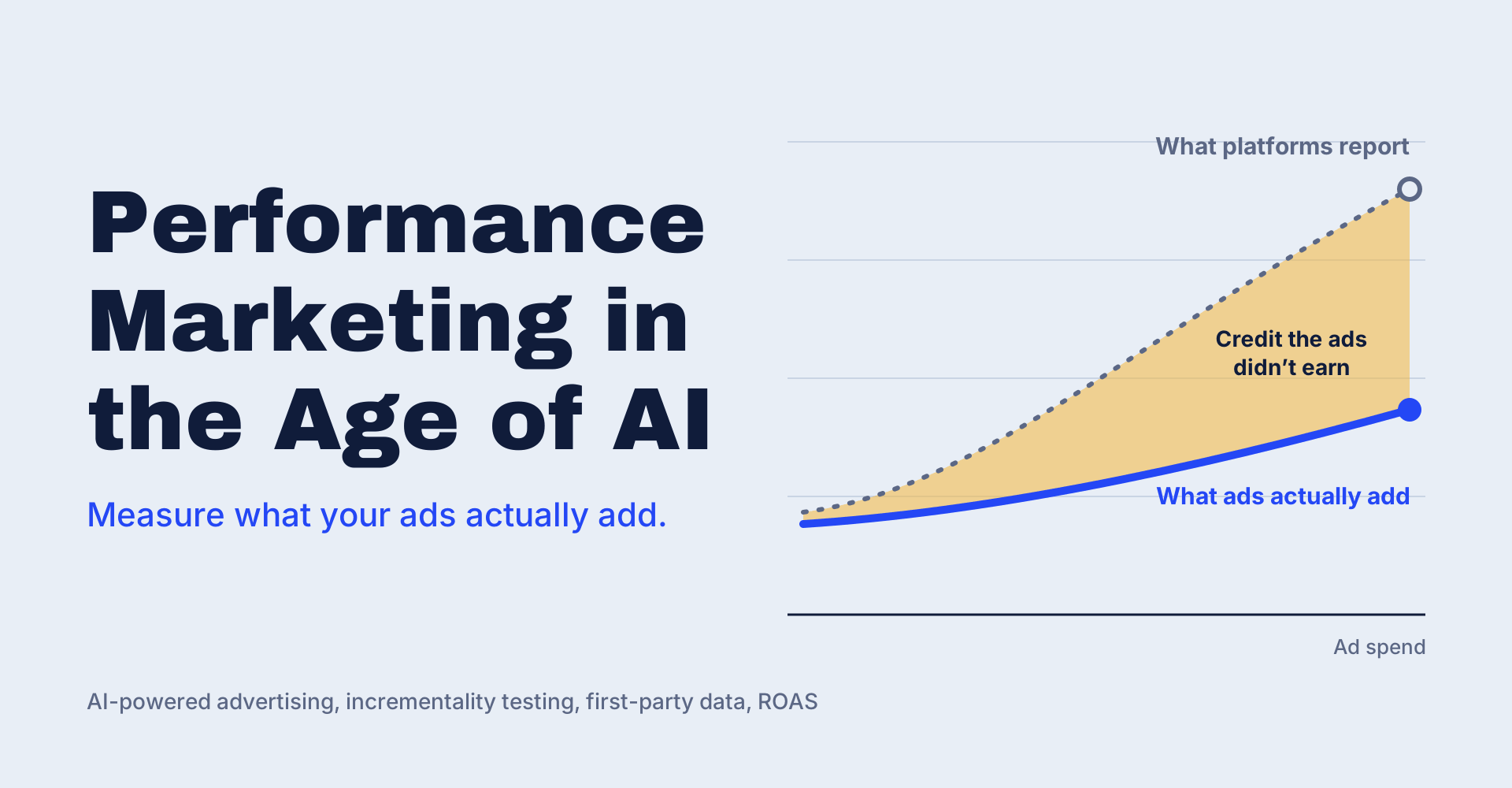
What has changed is how those results are produced and proven. Platforms now make many of the targeting and bidding decisions for you, while the old methods of proving results, such as last-click attribution and cookie-based tracking, have become far less reliable. That gap between what platforms report and what is actually driven by your ads is the central challenge of modern performance marketing.
Trend 1: AI Automation Has Taken Over the Controls
The biggest shift in performance marketing is the move from manual optimization to AI-driven campaign types. Google’s Performance Max and Meta’s Advantage+ campaigns are the best-known examples. Instead of choosing keywords, placements and audiences yourself, you supply budgets, goals, creative assets and conversion data. The algorithm decides who sees what, where and when.
This has real benefits. Automated bidding reacts to signals in real time, far faster than any human team can. It can find pockets of demand you would never think to target and it reduces the grind of daily bid adjustments.
But automation comes with trade-offs that every marketer should understand:
- Less transparency. Reporting on placements, search terms and audience segments is often limited, which makes it harder to learn why something worked.
- Garbage in, garbage out. AI optimizes toward the conversion signal you give it. If you optimize for cheap leads instead of qualified leads, the system will happily deliver more cheap leads.
- Self-grading homework. Platforms report their own results, and they have an incentive to claim credit for conversions that might have happened anyway.
The lesson is not to resist automation but to steer it. Your job shifts from pulling levers to supplying three things the algorithm cannot create on its own: clean conversion data, strong creative and sound business guardrails such as target CAC and margin thresholds.
Trend 2: Incrementality Is Replacing Last-Click Attribution
If one concept separates mature performance marketing teams from the rest, it is incrementality. The question is simple: how many conversions happened because of your advertising that would not have happened otherwise?
Last-click and platform-reported attribution can badly overstate performance, especially for branded search and retargeting, where you often pay to reach people who were already about to buy. A campaign can show a ROAS of 8x on paper while contributing very little new revenue.
Incrementality testing answers the real question. The most common methods include:
- Geo-lift tests: run ads in some regions, hold them back in comparable regions and measure the difference in sales.
- Conversion lift studies: platform-run experiments that compare a test group with a holdout group.
- Holdout testing: deliberately withhold ads from a small share of your audience to estimate baseline demand.
Alongside experiments, marketing mix modeling (MMM) has made a strong comeback. Modern MMM uses aggregated data rather than user-level tracking, which makes it privacy-friendly, and newer open-source tools have made it accessible to mid-sized brands rather than only enterprises. The best-practice approach is triangulation: combine MMM for the big-picture budget split, incrementality tests for validation and platform data for day-to-day optimization.
If you take one action from this section, make it this: run at least one incrementality test on your largest spend line this quarter. The results are often uncomfortable, and almost always valuable.
Trend 3: First-Party Data Is the New Competitive Advantage
Privacy regulation, browser restrictions and platform-level tracking limits have steadily eroded the third-party data that once powered audience targeting. Performance marketers who depended on it are feeling the squeeze. Those who invested in first-party data are pulling ahead.
First-party data is information your customers share directly with you: email addresses, purchase history, app behavior, loyalty program activity and survey responses. It is accurate, consented and uniquely yours. It matters for performance marketing in three ways:
- Better signals for AI. Feeding platforms with server-side events and enhanced conversions, such as the Conversions API on Meta and enhanced conversions on Google, helps automated bidding learn from more complete data.
- Smarter audiences. Customer lists can power lookalike modeling, suppression of existing customers and win-back campaigns.
- Value-based optimization. Instead of treating every conversion equally, you can tell the algorithm which customers are worth more and bid accordingly, optimizing for LTV rather than just the first purchase.
Practical steps include setting up server-side tracking, building a clear consent and value exchange (why should a customer share their email?), unifying data in a customer data platform or warehouse and connecting offline sales back to the ad platforms. Brands with strong first-party data also find it easier to participate in retail media, one of the fastest-growing corners of performance marketing, where retailers sell ad placements backed by their own shopper data.
Trend 4: Creative Is the New Targeting
When every advertiser uses the same automated targeting tools, audience selection stops being a differentiator. What remains is the one lever the algorithm cannot pull for you: creative.
Platforms increasingly use the ad itself as a targeting signal. A video that speaks to first-time parents, for example, will naturally find first-time parents. That means creative testing is no longer a nice-to-have but the main engine of performance.
High-performing teams treat creative as a system:
- Test concepts, not just tweaks. Changing a button color rarely moves results. Testing entirely different angles such as price, social proof, problem-solution or founder story does.
- Produce at volume. Short-form video, user-generated content and creator partnerships help you refresh ads before fatigue sets in.
- Use generative AI as a co-pilot. AI tools can speed up variations, headlines, resizing and first drafts, but human judgment on brand voice, truthfulness and emotional resonance remains essential. Always review AI-generated assets before they go live.
- Learn from the data. Tag every creative by hook, format and offer so you can see which elements consistently drive lower CAC.
A Five-Step Framework to Modernize Your Performance Marketing
Here is a simple, practical plan you can start using this month.
Step 1: Audit your measurement. Compare platform-reported results with your own backend sales data. Large gaps are a warning sign that attribution is overcounting.
Step 2: Fix your data foundation. Implement server-side tracking, clean up conversion events and import offline or qualified-lead data so the algorithm optimizes toward real business value.
Step 3: Set profit-based goals. Move beyond blended ROAS. Define target CAC by customer segment and tie goals to contribution margin and LTV.
Step 4: Test incrementality. Pick your biggest channel, design a holdout or geo-lift test and use the results to reallocate budget with confidence.
Step 5: Build a creative engine. Set a weekly cadence for new concepts, document learnings and retire fatigued ads quickly.
Repeat this loop each quarter. Performance marketing rewards teams that learn faster than their competitors, not those that simply spend more.
Common Mistakes to Avoid
- Trusting a single source of truth. No single dashboard tells the full story. Cross-check platform data, analytics tools and finance numbers.
- Over-investing in the bottom of the funnel. Retargeting and branded search harvest demand that other activity creates. Starve the top and the bottom eventually dries up.
- Changing too much too fast. Frequent edits reset learning phases in automated campaigns. Give tests enough time and budget to produce reliable results.
- Ignoring the landing page. Even the best ad cannot rescue a slow, confusing or mobile-unfriendly page. Conversion rate optimization is part of performance marketing, not an afterthought.
Conclusion: Human Strategy, Machine Execution
Performance marketing is not becoming less human. It is becoming more strategic. As AI handles bidding and placement, the work that creates an advantage moves upstream: defining the right goals, owning first-party data, proving true incremental impact and producing creative that people actually want to watch.
The marketers who thrive will be those who treat automation as a powerful engine, not an autopilot. Give it clean data, clear guardrails and great creativity, then verify its results with independent measurement. Do that consistently and lower CAC and healthier ROAS follow.
Ready to take the next step? Start with a single incrementality test on your largest channel this quarter. The insight alone may change how you spend your next budget.