

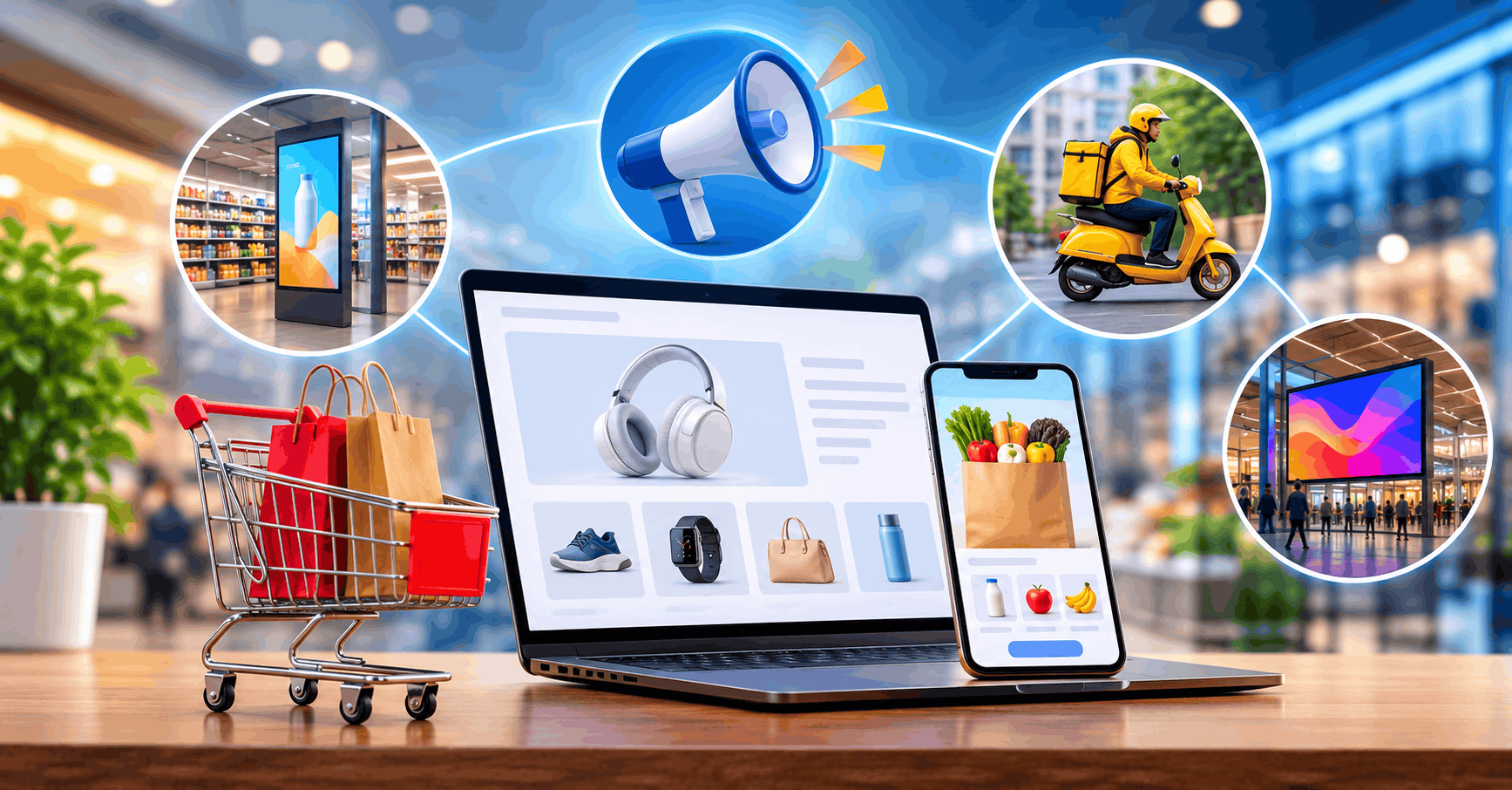


Retail media networks now sit next to search and social in many brand media plans. So what is a retail media network? It is an advertising business run by a retailer, which sells ad space on its own apps, websites and stores and targets shoppers with its own purchase data. Retail media advertising, from sponsored product ads to in-store screens, reaches people who are already shopping, and that is why ecommerce advertising budgets keep moving this way. This guide explains how the model works, where quick commerce fits in India, how to measure results and how to build a retail media strategy for 2026.
What Is a Retail Media Network and How Do Retail Media Networks Work?
A retail media network (RMN) is an advertising platform owned by a retailer. Retail ad networks sell placements on the retailer’s website and app, on outside sites through off-site campaigns, and increasingly on screens inside physical stores.
So, how do retail media networks work? Most share three layers. First, a first-party data foundation: purchases, searches, loyalty activity and browsing behaviour. Second, activation: the ad placements themselves. Third, closed-loop measurement, which links ad exposure to actual sales.
The workhorse format is sponsored product ads. A brand pays to promote a specific product in search results or category pages, usually through an auction. Unlike traditional digital advertising, which often leans on inferred interests, retail media targets what people actually bought, and the ad appears close to the moment of purchase.
Retail media vs commerce media. The difference between retail media and commerce media is scope. Retail media is the advertising a retailer sells using its shopper data. Commerce media is the wider umbrella, covering any media tied to transactions, including airlines, hotels and banks. That wider field includes non-endemic retail media: advertisers whose products the retailer does not sell. Reports on Zepto’s IPO filing, for example, say it has sold ad space to non-selling brands such as CRED and AU Small Finance Bank.
Why Retail Media Networks Matter in 2026
Three forces drive growth. Brands want first-party data advertising that survives the decline of third-party cookies. They want outcomes they can measure in sales, not only clicks. And they want to reach buyers at the point of decision.
India shows the scale. WPP Media’s This Year, Next Year report expects Indian retail media to pass ₹30,000 crore in 2026, roughly 15% of total ad revenue. Quick commerce is a fast-growing slice: Pitch Madison estimates quick commerce advertising grew from about ₹300 crore in 2023 to roughly ₹4,000 crore in 2025. Treat these as directional, because agencies define “retail media” differently and their totals differ.
That is the core of retail media network trends in India 2026: marketplaces such as Amazon and Flipkart still lead, while Blinkit, Zepto and Instamart grow quickly from smaller bases.
For retail media marketing, the shift also supports omnichannel retail media, where one shopper is reached on-app, off-site and in-store. Many teams pair these audiences with other channels, such as Spotify and podcast advertising, to build awareness before shoppers open a retail app. This guide to digital audio advertising covers that side.
Major Retail Media Advertising Formats in 2026
On-Site Retail Media and Sponsored Product Ads
On-site inventory is the digital retail media core: sponsored listings in search, promoted products on category pages, display banners and brand pages inside the retailer’s app or site. It captures shoppers who are ready to buy, so it usually anchors performance goals.
Off-Site Retail Media and Retail Media DSP Buying
Off-site retail media uses a retailer’s audience data to reach shoppers on the open web, social and streaming. Brands typically buy it through programmatic advertising and demand-side platforms (DSPs). Some retailers run their own retail media DSP; Walmart, for instance, launched one with The Trade Desk. Others offer private marketplace deals into a DSP of the brand’s choice.
In-Store Retail Media and Digital Signage Advertising
In-store retail media covers digital screens, checkout displays, electronic shelf tags and in-store audio. In-store digital signage advertising lets a brand reach a shopper at the shelf. Walmart Connect and Kroger Precision Marketing are the usual in-store retail media network examples; I could not verify comparable large-scale programmes in India, so treat that as an open opportunity. Measurement is looser here: industry guidelines define an in-store impression as an opportunity to see the ad, not proof that someone saw it.
CTV Retail Media and Emerging Formats
CTV retail media connects streaming ads to retail purchase data. Walmart’s Vizio acquisition and Instacart’s measurement partnership with Roku show the direction. If you are planning this layer, read our guide to connected TV advertising for audience targeting and formats.
Quick Commerce Advertising in India: Blinkit Ads, Zepto Advertising and Swiggy Instamart Ads
Quick commerce advertising works because shoppers open these apps with a purchase in mind, and they open them often. Blinkit’s ad and promotion revenue reportedly crossed ₹1,000 crore on an annualised basis in 2025. Zepto launched Jarvis, an in-house ad service, in November 2024, and Swiggy runs a self-serve ads platform that also covers Instamart.
Top quick commerce ad formats. Platforms change formats often, and I could not access official media kits, so this list draws on trade press and agency guides. Confirm availability in each advertiser dashboard.
- Sponsored listings in search and category results, usually paid per click. Trade reports say brands put most of their money here.
- Banners on the home screen and category pages for launches and awareness.
- Post-order and order-tracking placements, reported on Zepto.
- Push notifications, which an Instamart marketing head names as an option.
- Cart-level and carousel units, which agency guides describe on Blinkit.
How to advertise on Blinkit and Zepto. Get your brand listed and in stock first, then open the platform’s ad tools or work through the account team. Agency guides suggest starting with one or two priority SKUs. Zepto routes brand advertising through Jarvis.
Hyperlocal dark store advertising strategy. Quick commerce is inventory-led. Platforms rank products partly on sales volume and availability, and an ad for an out-of-stock item wastes budget. Target the cities and pin codes where your dark-store stock is healthy, and pause spend when it runs low.
Quick commerce advertising strategy for FMCG brands. FMCG, personal care, food, beverage, D2C and household brands should defend category keywords with sponsored listings and use banners for launches. Pair ads with offers, and expect pricier slots around festivals, since trade reports note rate hikes before festive peaks. Read return claims carefully: Zepto’s IPO filing cites a Redseer estimate of 5–8x ROAS, but one small-brand founder told Storyboard18 returns rarely beat 1.2–1.5x.
Popular Retail Media Network Platforms and Their Advertising Opportunities
Start by separating international examples from Indian ones. Amazon Advertising offers Sponsored Products, Sponsored Brands, Sponsored Display, Amazon DSP and streaming placements, and it operates in India. A sound Amazon Advertising strategy pairs search ads with brand-building units and tests incrementality. Walmart Connect is a US example, not an Indian one, though Walmart-owned Flipkart runs Flipkart Ads in India alongside Amazon Ads and JioMart.
The best retail media networks for D2C brands depend on category and distribution. In India, many D2C brands begin with Amazon, Flipkart and one quick commerce platform, which Instamart’s team describes as a discovery channel for newer brands.
When you evaluate retail media network platforms, compare audience reach, category fit, targeting options, reporting depth, costs and attribution method.
How to Measure Retail Media ROAS and Campaign Performance
Retail media ROAS (return on ad spend) shows the sales credited to a campaign for every rupee spent:
ROAS = attributed sales ÷ ad spend
If you spend ₹50,000 and the retailer attributes ₹2,50,000 in sales, ROAS is 5x. That is how to measure ROAS in retail media networks at its simplest, and it relies on closed-loop attribution retail media: the retailer matching ad exposure to purchases in its own data.
Track impressions, clicks, click-through rate, conversion rate, attributed sales and ROAS. Then add the metric that matters most: incremental sales. Attribution assigns credit; it does not prove cause. Suppose an RCT shows only ₹1,00,000 of those sales would not have happened without the ads. Your incremental ROAS is 2x, not 5x. IAB and IAB Europe published guidelines for incremental measurement in commerce media in November 2025. Our guide to CTV advertising and campaign measurement covers parallel concepts.
Use results to shift budget toward the keywords, SKUs and locations with the strongest incremental return.
Key Retail Media Challenges and Future Trends in 2026
Challenges of retail media fragmentation. Each network has its own metrics, formats and reporting. IAB and the Media Rating Council have published measurement guidelines, but adoption is uneven, and brands still struggle to compare networks. In India, an industry voice has called the larger platforms “mini” walled gardens, given their control of data.
First party data monetization for retailers. Retailers turn loyalty and transaction data into high-margin ad revenue. This is established practice. Retail media DSP technology and off-site activation are also established.
Emerging developments deserve more caution:
- AI in retail media already helps with bidding, optimization and reporting at some platforms. Fully autonomous “agentic” buying remains more aspiration than reality.
- Non-endemic retail media is growing, led by Amazon and some Indian apps.
- Omnichannel retail media that links screens, apps and stores remains uneven.
How Brands Can Build an Effective Retail Media Strategy in 2026
A workable retail media strategy follows six steps:
- Define objectives and audiences: sales, new-to-brand customers or launches.
- Select platforms: match audience, categories and distribution.
- Choose formats: sponsored listings for demand capture, banners and off-site for reach.
- Set and split budgets: fund tests and measurement as a separate line.
- Track ROAS, conversions and incremental sales.
- Improve continuously: reallocate based on performance data.
Retail media networks are becoming central because they connect advertising to purchase data. Brands that fix inventory, pick a few platforms and demand incrementality will be ready as formats expand.