



Marketing has always had one important responsibility: bringing customers closer to a business. But the way it achieves that goal is changing faster than ever.
A few years ago, businesses measured marketing success through website visits, impressions, clicks, and social media engagement. More traffic generally meant more opportunities, and more leads were expected to produce more sales.
However, today’s businesses are discovering an important reality: getting attention is easy compared to converting that attention into revenue.
A campaign can generate thousands of clicks and still fail to bring meaningful sales. Another campaign with a smaller audience might generate fewer leads but deliver significantly better revenue.
This is where artificial intelligence (AI) is changing the role of performance marketing.
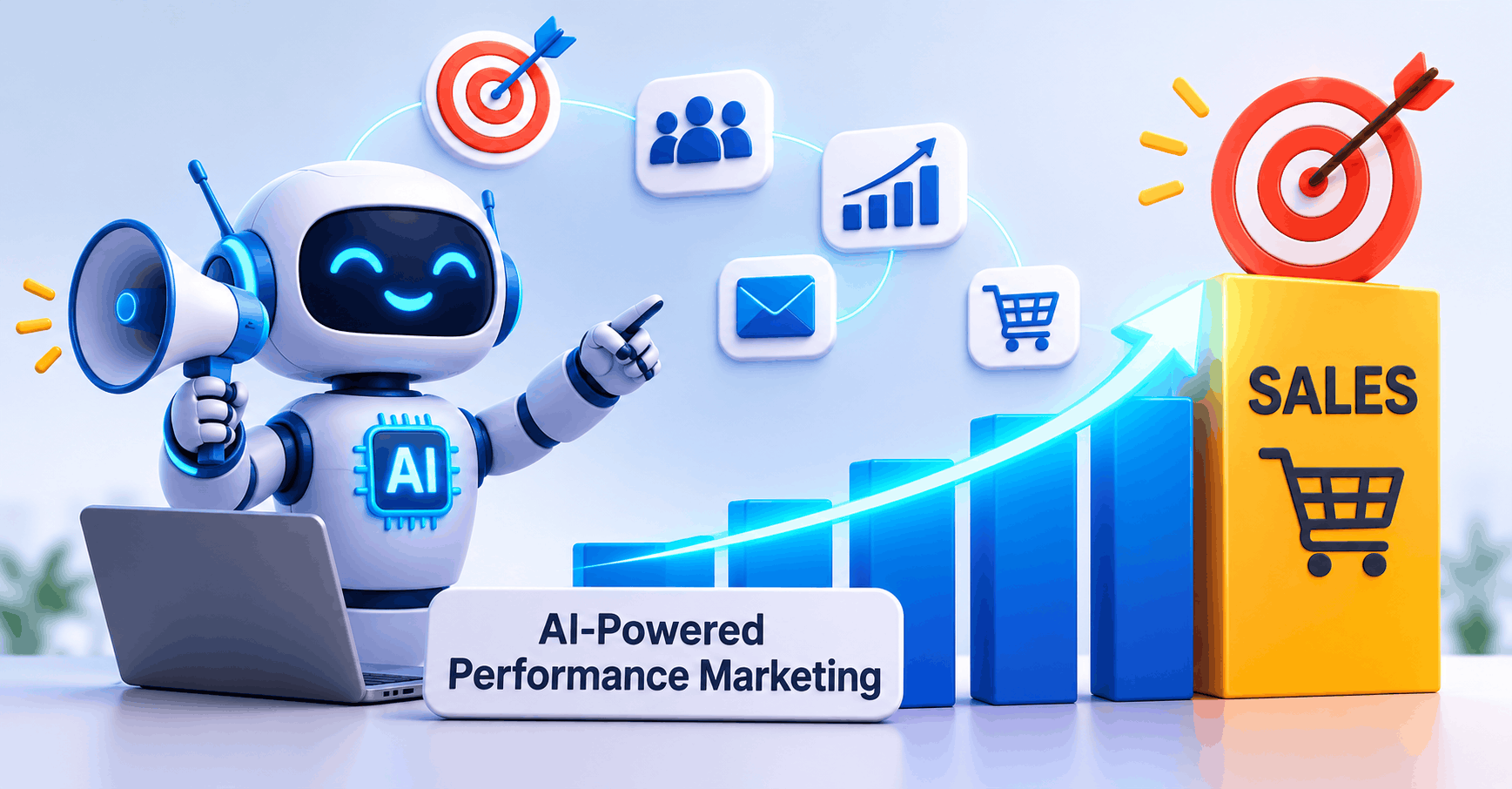
AI is helping marketers understand customer behaviour, identify purchase intent, optimise advertising campaigns, personalise communication, and improve the entire journey from the first interaction to the final purchase.
Performance marketing is no longer just about paying for clicks or generating enquiries. It is increasingly about understanding what makes customers buy and using that information to create measurable business growth.
Let’s explore how this transformation is happening and why AI-powered performance marketing is becoming an important part of modern sales strategies.
1. From Finding Audiences to Understanding Buying Intent
Traditional digital advertising often started with audience selection.
Marketers created audience groups based on age, location, gender, interests, demographics, and online behaviour. They then designed advertisements for those groups and waited to see which audience performed better.
Although this approach still has value, AI has introduced a more intelligent way of identifying potential customers.
Instead of simply asking who might be interested in a product, AI-powered marketing systems can analyse behavioural signals that indicate who is more likely to purchase.
For example, consider a company selling industrial heating equipment.
A person casually visiting its website might only be researching different heater types. However, another visitor might repeatedly check product specifications, download technical catalogues, visit pricing pages, and submit an enquiry.
These two visitors have different levels of purchase intent.
AI can help identify these behavioural patterns and support marketers in prioritising high-intent audiences.
The result? Businesses can move beyond advertising to everyone who might be interested and focus more attention on people showing genuine buying signals.
This creates a stronger connection between advertising investment and actual sales opportunities.
2. Predictive Analytics: Identifying Sales Opportunities Before They Happen
One of the most interesting developments in AI-powered performance marketing is predictive analytics.
Traditional reporting tells businesses what has already happened. It shows how many people clicked an advertisement, how much money was spent, and how many leads were generated.
Predictive analytics takes the next step by using historical and behavioural data to estimate what might happen next.
AI-powered systems can analyse information such as:
- Previous purchase behaviour.
- Website browsing patterns.
- Customer engagement history.
- Lead quality and conversion rates.
- Advertising campaign performance.
- Product and service preferences.
Based on these patterns, businesses can identify audiences that may have a higher probability of converting.
Imagine an online fashion store receiving 5,000 website visitors every day. Instead of treating every visitor equally, AI can help identify which visitors are more likely to purchase based on their interactions.
The business can then develop separate strategies for different customer groups.
For example, visitors who viewed products repeatedly might receive remarketing advertisements, while existing customers could receive personalised product recommendations.
Predictive analytics does not guarantee future sales, but it helps businesses make better-informed marketing decisions.
3. AI Is Changing How Advertising Budgets Generate Revenue
Every business wants better returns from its advertising budget.
However, increasing the advertising budget does not automatically increase sales. If a campaign is targeting the wrong audience or attracting low-quality leads, spending more money can simply increase the losses.
AI is changing how advertising platforms distribute budgets and optimize campaigns.
Platforms such as Google Ads and Meta Ads use machine learning to analyse campaign signals and optimise delivery towards selected objectives.
Some important AI-powered capabilities include:
- Automated bidding based on conversion goals.
- Dynamic audience expansion.
- Creative and placement optimisation.
- Conversion prediction.
- Performance-based budget allocation.
- Automated campaign insights.
For example, a business running multiple Google Ads campaigns might discover that one campaign generates 100 enquiries while another generates only 40.
At first glance, the first campaign appears more successful.
But what if the first campaign produces only five paying customers, while the second produces 20?
This changes the entire calculation.
| Campaign | Leads | Sales | Lead-to-sale rate |
| Campaign A | 100 | 5 | 5% |
| Campaign B | 40 | 20 | 50% |
Campaign B generates fewer enquiries but produces four times as many sales.
This is why AI-powered performance marketing should focus on business outcomes rather than treating lead volume as the ultimate measure of success.
4. Personalisation: Making Every Customer Feel Understood
Customers rarely purchase products for exactly the same reasons.
One customer might choose a product because of its price. Another might prioritise quality, convenience, durability, customer support, or brand reputation.
Generic advertisements often struggle to communicate with all these different motivations.
AI makes personalised marketing more scalable.
By analysing customer interactions and preferences, businesses can create more relevant experiences across different marketing channels.
Consider an education consultancy.
A student looking for an overseas education programme might be interested in university selection, admission requirements, scholarships, or visa guidance.
Showing the same advertisement to every student may not generate the best results.
AI-powered personalisation can help marketers organise audiences according to their interests and deliver more relevant communication.
The same principle applies to ecommerce, healthcare, manufacturing, real estate, and professional services.
Personalisation can improve:
- Email marketing engagement.
- Product recommendations.
- Remarketing campaigns.
- Website experiences.
- Advertising relevance.
- Customer retention.
The objective is not to make every advertisement look different simply because AI can generate variations.
It is to make every marketing interaction more relevant to the customer’s actual needs.
5. AI-Powered Lead Scoring: Stop Treating Every Enquiry Equally
Generating leads is only the beginning of the sales process.
Many businesses struggle because their sales teams spend valuable time contacting enquiries that have little intention of purchasing.
This creates delays, increases operational costs, and reduces the time available for serious prospects.
AI-powered lead scoring helps address this problem.
It analyses available customer information and assigns priority based on signals associated with conversion potential.
For example, an industrial equipment manufacturer may receive enquiries from:
- Students researching industrial equipment.
- Small businesses comparing prices.
- Procurement managers looking for bulk requirements.
- Manufacturers seeking an immediate equipment replacement.
Although all four enquiries are valuable, their buying intentions and timelines may be very different.
AI can help classify and prioritise these enquiries using factors such as company details, engagement history, enquiry information, and previous conversion patterns.
The sales team can then focus on high-priority prospects while maintaining follow-up communication with other leads.
However, lead scoring should not replace human judgement. AI recommendations need to be reviewed against real sales outcomes and business requirements.
6. Creative Is Becoming a Bigger Competitive Advantage
One major misconception about AI in performance marketing is that automation alone can produce successful campaigns.
It cannot.
Advertising platforms can optimize delivery, but they still need compelling creative material that makes people stop scrolling and pay attention.
In fact, as automated targeting becomes more accessible, creative quality becomes an increasingly important competitive advantage.
AI now helps marketers produce and test:
- Multiple advertisement headlines.
- Different visual concepts.
- Short-form video variations.
- Product descriptions.
- Landing page content.
- Personalised advertising messages.
For example, a business selling premium skincare products could test three different creative directions:
- Product-focused messaging highlighting ingredients.
- Customer-focused messaging highlighting skincare routines.
- Benefit-focused messaging highlighting the overall experience.
AI can help develop these variations and analyse their performance.
But the most successful creative is not necessarily the one with the most attractive design.
It is the one that communicates the right value proposition to the right customer at the right stage of the buying journey.
Automation can produce more creative options, but understanding customers is what makes those options effective.
7. Faster Customer Responses Can Directly Influence Sales
Here is something many businesses overlook: a marketing campaign can perform exceptionally well and still lose sales because the company responds too slowly.
Imagine a customer submitting an enquiry through a website at 11:00 AM.
The business responds at 5:00 PM.
During those six hours, the customer may have already contacted three competitors and received their quotations.
The advertising campaign did its job. The sales process did not.
AI-powered chatbots, automated communication systems, and CRM integrations can help businesses respond to enquiries faster.
They can support activities such as:
- Answering frequently asked questions.
- Collecting basic customer information.
- Qualifying enquiries.
- Scheduling appointments.
- Sharing product information.
- Sending follow-up reminders.
- Routing enquiries to the appropriate sales representative.
For example, an AI chatbot on a real estate website can ask visitors about their preferred location, budget, property type, and buying timeline.
The sales team receives more organised information and can follow up with relevant options.
However, sensitive discussions, complex objections, negotiations, and final purchase decisions still benefit from human involvement.
The strongest approach combines AI-powered speed with human sales expertise.
8. Connecting Marketing Data With Actual Sales Results
One of the biggest challenges in performance marketing is understanding which campaigns genuinely contribute to revenue.
A business might generate leads through Google Ads, Instagram, Facebook, organic search, and referral traffic.
Without proper tracking, it becomes difficult to understand which channels are attracting customers who actually purchase.
AI becomes more useful when it has access to reliable first-party data and accurate conversion tracking.
By integrating advertising platforms with CRM systems, businesses can connect marketing activity with sales outcomes.
For example:
Advertising click → Website visit → Enquiry → Sales follow-up → Qualified opportunity → Purchase
This gives marketers a more complete picture of the customer journey.
Instead of reporting only cost per lead (CPL), businesses can evaluate:
- Customer acquisition cost (CAC).
- Lead-to-sale conversion rate.
- Cost per qualified lead.
- Return on ad spend (ROAS).
- Customer lifetime value (CLV).
- Revenue generated by individual campaigns.
This is particularly important for businesses with longer sales cycles, such as manufacturing, real estate, education, and B2B services.
A campaign that looks expensive at the lead-generation stage might eventually produce highly profitable customers.
Without connecting marketing data to sales data, businesses may stop campaigns that are actually delivering long-term value.
9. The Human Factor: Why AI Cannot Replace Marketing Strategy
Despite all these advancements, AI is not a replacement for strategic thinking.
It can analyse data, identify patterns, automate repetitive work, and generate recommendations. But it does not automatically understand every business challenge.
For example, AI might identify an advertisement generating a high number of conversions. However, a marketing strategist must still determine whether those conversions represent profitable customers.
Similarly, AI-generated content might look professional but fail to communicate the brand’s actual positioning.
Businesses still need people who understand:
- Customer psychology.
- Brand positioning.
- Market competition.
- Product differentiation.
- Sales objections.
- Business profitability.
- Long-term growth strategies.
The future of performance marketing is not AI versus humans.
It is AI working alongside experienced marketers and sales professionals.
The technology handles data-heavy and repetitive tasks, while people provide creativity, context, decision-making, and business direction.
10. What Businesses Should Do to Prepare for AI-Driven Performance Marketing
Businesses do not need to adopt every AI tool available in the market.
A more practical approach is to strengthen the marketing foundation first.
Here are five steps worth prioritising:
1. Fix conversion tracking: Make sure website enquiries, phone calls, purchases, and other meaningful actions are measured correctly.
2. Organise customer data: Maintain a reliable CRM system to understand lead quality, sales progress, and customer behaviour.
3. Optimise for revenue: Evaluate campaigns based on qualified opportunities and actual sales, not just clicks and impressions.
4. Experiment with AI: Use automation, predictive insights, creative testing, and personalisation where they solve real business problems.
5. Keep humans involved: Regularly review AI recommendations, advertising messages, customer experiences, and campaign profitability.
The goal should be to build a marketing system that continuously learns from customer behaviour and improves business performance.
Conclusion: The Future Belongs to Marketing That Understands Sales
AI is changing performance marketing from a campaign-focused activity into a more connected, data-driven business growth process.
It is helping companies understand buying intent, improve advertising efficiency, personalise customer experiences, prioritise qualified leads, and connect marketing investments with actual revenue.
But there is an important distinction: AI does not create business growth simply by being introduced into a marketing campaign. Growth happens when technology, accurate data, strong creative, and a well-managed sales process work together.
Businesses that continue measuring success only through clicks and impressions risk missing the bigger opportunity.
The next stage of performance marketing is about understanding the complete customer journey, from the first advertisement to the final transaction and beyond.
For businesses looking to compete in 2026 and beyond, the question is no longer whether AI should be part of marketing.
The more important question is how intelligently it can be used to turn marketing investments into measurable sales growth.
At SmartFish Designs, the opportunity lies in combining performance-driven advertising, creative strategy, data analytics, and AI-powered marketing solutions to help businesses move beyond generating leads and focus on generating meaningful business outcomes.