




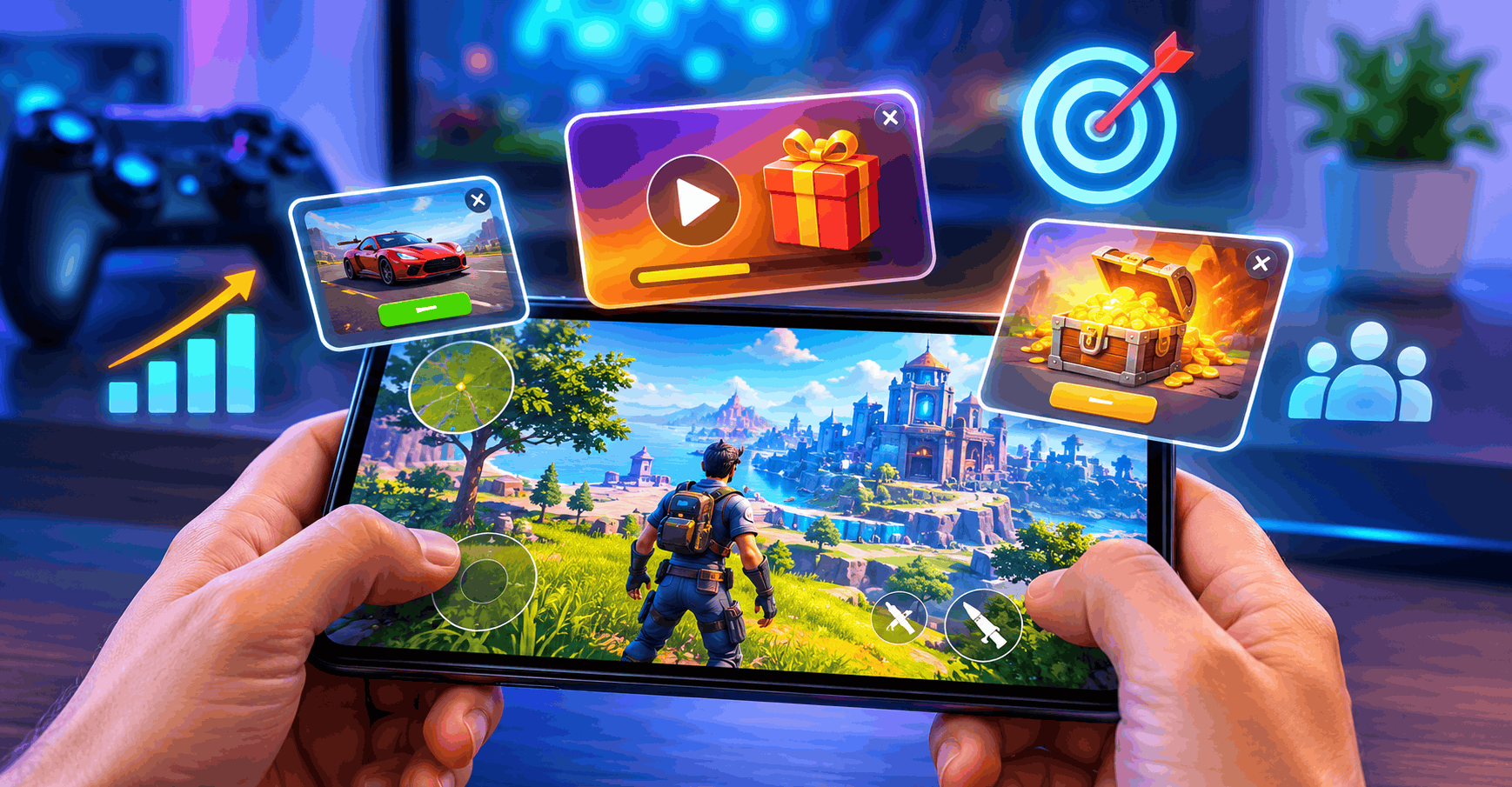


In-game advertising now sits at the centre of gaming marketing. Newzoo forecasts a $213.9 billion games market in 2026, and mobile is its largest segment. Mobile game advertising reaches that audience through rewarded video ads, playable ads, and in-app advertising formats built into gameplay. Smarter gaming audience targeting, solid ad campaign measurement, and fair game monetization decide who wins. This guide also covers intrinsic in-game ads.
What Is In-Game Advertising? Understanding Its Role in 2026
In-game advertising means placing brand messages inside games, either as ad units that appear during play or as elements of the game world itself. In-app advertising is the broader category covering any app, including utilities and news. Game ads can be tied to player behaviour, such as a level ending or a reward being offered.
The model works for three groups:
• Advertisers reach engaged audiences.
• Developers earn revenue without forcing every player to pay.
• Players get free games and, with opt-in formats, a choice.
The key distinction is between interruptive formats, which pause play, and intrinsic in-game ads, which live inside the game world.
Popular Mobile Game Advertising Formats in 2026
GameAnalytics reports that video makes up about 74% of mobile game ads, with clips under 30 seconds forming most of that. It also says creatives in mature markets such as the US, UK and Germany burn out in under five days. Format choice therefore matters less than how often you refresh creative.
Rewarded Video Ads: Monetisation Without Disrupting Gameplay
Rewarded video ads give players currency, extra lives, or energy in exchange for watching. Because players opt in, they tend to tolerate these ads better than forced ones. GameAnalytics cites typical rewarded video eCPM benchmarks of roughly $10–30 in top-tier markets. Treat that as a directional range from one source, because eCPM shifts with geography, platform, genre, fill rate, and advertiser demand.
Rewarded ads can also help reduce player churn. Offering a revive after a failed level, for example, gives a frustrated player a reason to continue. Place offers at natural pauses and never block progress behind them.
Playable Ads: Turning Advertisements into Interactive Experiences
Playable ads let users try a short slice of the game before installing. That helps mobile game user acquisition because installs come from people who already understand the mechanic. GameAnalytics reports playables averaging 4.8 installs per thousand impressions versus 2.9 for video. Those are one provider’s averages, so test them against your own data.
On playable ad creative strategy:
• Show the core mechanic within seconds.
• Keep onboarding minimal.
• Make the first action obvious.
• Place the call to action (CTA) once the player feels competent, using clear wording such as “Play Now.”
Interactive end cards on mobile games offer a cheaper middle ground: a standard video followed by an interactive finish. Games with complex systems often suit this better than a full playable game.
Rewarded video ads vs playable ads conversion rates: no reliable universal comparison exists. Rewarded video is mainly a monetisation format, while playables are mainly an acquisition format, so compare each against its own goal.
Intrinsic In-Game Ads: Advertising Integrated into Gameplay
Intrinsic placements include stadium boards, billboards, branded objects, and digital signage in virtual worlds. They differ from mobile display banners because they appear as part of the scene rather than over it. Brands that already run digital out-of-home advertising will recognise the logic: a message in a believable environment, seen without interruption.
For attention metrics for intrinsic in-game advertising, look at on-screen time, screen share, viewing angle, and object size rather than clicks. A billboard glimpsed for half a second counts for far less than one in a player’s line of sight.
Best Mobile Game Ad Networks 2026 and Programmatic In-Game Advertising Platforms
Ad networks connect publishers with advertiser demand. In mobile, GameAnalytics names Meta, TikTok, Google, AppLovin, Unity Ads, and ironSource as places where video spend concentrates. This is a description of where spend sits, not a ranking.
Programmatic in-game advertising platforms automate buying through real-time auctions, replacing manual deals. When choosing one, compare:
• reach in your target markets
• targeting options
• measurement support
• pricing model
• brand-safety controls
• integration effort
Brands used to programmatic buying in other channels will find the auction logic familiar. Request a test before committing a budget.
Gaming Audience Targeting: Reaching the Right Players in 2026
“Gamers” is not one audience. OnAudience notes that genre interest, platform, content habits, device ownership, and shopping behaviour all differ. A casual mobile player and a console shooter fan respond to different messages. Segment by genre, engagement, and spending patterns, and match creative to casual, mid-core, or hardcore players.
First-party gaming audience data, collected inside your own game with consent, is the strongest asset because you control its quality. Privacy-first gaming ad targeting builds on it with contextual signals and consented data.
How to target gamers without third party cookies: combine contextual targeting (the game’s genre or content), first-party data, and consented identifiers. Mobile environments rely less on cookies anyway, but device-level tracking is also more restricted than it once was.
Non-Endemic Brand Gaming Ads: Opportunities Beyond the Gaming Industry
Endemic brands, such as game publishers and hardware makers, belong to the gaming industry. Non-endemic brands come from outside it. OnAudience points out that major launches can lift interest in consoles, TVs, broadband, and entertainment, so electronics, telecom, and retail advertisers all have openings.
How non-endemic brands advertise in mobile games:
• rewarded offers
• branded in-game objects
• sponsored events
• contextual placements matching the game’s theme
Finance, automotive, FMCG, and entertainment brands can all fit, if the message suits the setting. Retailers can also connect gaming reach with retail media networks for closer-to-purchase measurement. Relevance and restraint protect the player experience.
Ad Campaign Measurement: How to Measure In-Game Ad Campaign ROI in 2026
Track metrics in layers:
• Exposure: impressions, viewability, and video completion rate.
• Engagement: interaction rate, CTR, and conversion rate.
• Cost: eCPM and cost per acquisition (CPA).
• Outcome: ROAS, ROI, retention, and player engagement.
• Attention: how long and how clearly the ad was seen.
A simple framework for how to measure in-game ad campaign ROI in 2026:
1. Set one business goal, such as installs, sales, or sign-ups.
2. Choose matching metrics from the layers above.
3. Compare exposed and unexposed groups where possible.
4. Calculate ROI as (attributed revenue − total cost) ÷ total cost.
5. Review by creative, title, and audience.
Cross-title campaign attribution is hard because players move between games, devices, and ad environments. Use consistent tracking, and use holdout tests to estimate how much impact the campaign actually caused.
Mobile game user acquisition cost benchmarks 2026: published CPI figures vary widely by genre, platform, country, and reporting period, and sources disagree. Check a current dataset such as AppsFlyer’s quarterly gaming benchmarks for your segment. Higher-value genres and Tier 1 markets cost more because players there tend to be worth more.
Best Practices for Running Successful In-Game Advertising Campaigns
• Choose format by goal. Use rewarded video for monetisation, playables for acquisition, and intrinsic placements for awareness.
• Match creative to the audience. Casual players and hardcore players want different tones.
• Balance revenue and experience. Cap frequency and favour opt-in formats.
• Optimise playables. Test onboarding length and CTA timing.
• Refresh and test creativity often. GameAnalytics points to refresh cadence as a major performance driver.
• Monitor continuously. Google Ads automation can handle budget alerts and automated advertising reporting for the paid-search side.
• Think cross-channel. Digital audio advertising can support a gaming launch where players listen to podcasts or streaming.
• Stay privacy-first. Build consent into targeting and measurement.
The Future of In-Game Advertising: Key Trends to Watch Beyond 2026
Several shifts are already visible:
• More automated buying.
• Heavier use of consented first-party data.
• Growing demand for measurable results.
• Wider interest from non-endemic brands.
• Ads that blend more naturally into game worlds.
Which formats gain most will depend on how players respond.
Frequently Asked Questions About In-Game Advertising
What is the difference between in-game advertising and in-app advertising? In-app advertising covers ads in any mobile app. In-game advertising focuses on games and includes formats tied to gameplay, such as rewarded ads and intrinsic placements.
Are rewarded video ads better than playable ads? Neither is better overall. Rewarded video suits monetisation, while playable ads suit user acquisition for games with a mechanic that can be shown quickly.
How do advertisers target gamers without third-party cookies? They use contextual targeting, consented first-party data, and genre or behaviour signals from within games.
How can businesses measure ROI from in-game advertising? Define one goal, track matching metrics, compare against a control group where possible, and calculate (attributed revenue − cost)