

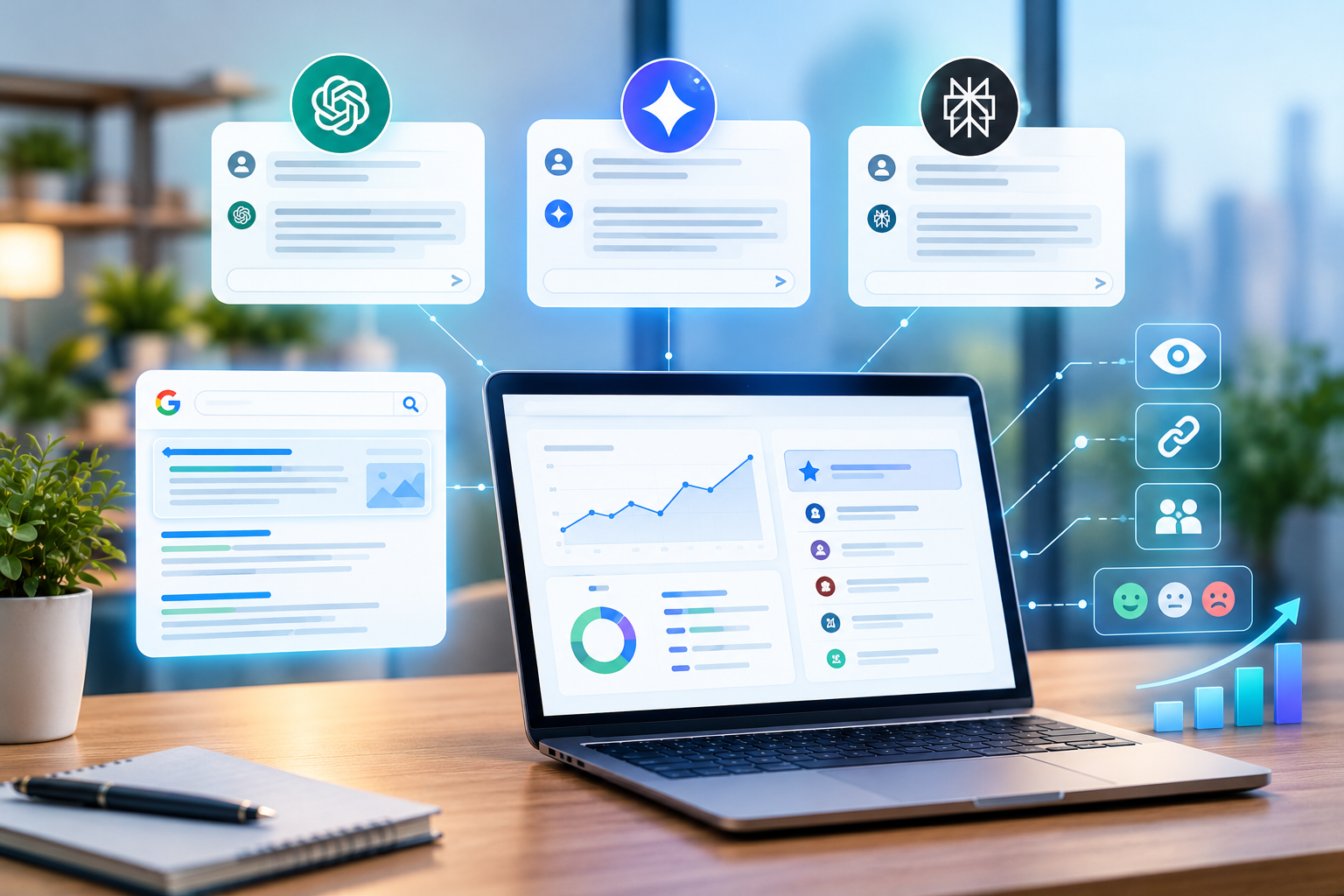


For two decades, the scoreboard of digital marketing was simple: type a query into Google, find your link, and note the position. Ranking number one meant traffic, leads and revenue. That scoreboard is now incomplete. A growing share of discovery happens inside conversations, where a user asks ChatGPT, Gemini or Perplexity a question and receives one synthesised answer instead of ten blue links.
In that answer, either your brand is named or it is not. There is no page two. This is why AI visibility has become one of the most important metrics for modern brands, and why relying only on keyword rankings is a risky strategy.
What Is AI Visibility?
AI visibility is the degree to which your brand, products, content and expertise are mentioned, recommended or cited in answers produced by generative AI tools. It is closely related to what the industry calls Generative Engine Optimization (GEO) and Answer Engine Optimization (AEO).
AI visibility is usually measured across a few dimensions:
- Brand mentions: Does the AI name your brand when asked a relevant question?
- Citations: Does it link to or reference your website as a source?
- Share of voice: How often are you mentioned compared with competitors for the same set of prompts?
- Sentiment and accuracy: Is the description of your brand positive, neutral or negative, and is it factually correct?
- Position within the answer: Are you the first recommendation or an afterthought in a list?
Why AI Visibility Matters More Than Keyword Rankings
1. The click is disappearing
Traditional SEO was built on the click. Users scanned results and chose a link. AI assistants and AI-generated summaries compress that journey: the answer is delivered directly, often with no need to visit any website. Industry studies on zero-click searches have repeatedly shown that when an AI summary appears, click-through rates to traditional results tend to fall. A high ranking that no longer earns a click is a weaker asset than it used to be.
2. AI gives one answer, not ten options
A search results page gives your brand multiple chances to appear: organic listings, snippets, maps, videos and ads. A large language model (LLM) typically names a handful of brands at most. The competition is far more concentrated, and the winners take a disproportionate share of attention and trust.
3. Recommendations carry built-in trust
When an AI tool says “for a mid-sized manufacturer, these three vendors are worth considering,” users treat it like advice from a knowledgeable colleague. That implied endorsement influences purchase decisions earlier in the funnel, often before the user ever visits a search engine or a brand website.
4. Ranking and being mentioned are not the same thing
A page can sit in the top three for a target keyword and still be absent from AI answers. LLMs assemble responses from many signals: training data, retrieval from live web results, reputation across third-party sites, reviews, forums, news coverage and structured data. Brands that dominate Google but have a thin presence elsewhere can be invisible in AI answers, while a smaller brand with strong digital PR and community mentions gets named repeatedly.
5. Search behaviour is becoming conversational
Users now ask longer, more specific, more contextual questions: “Which hospital equipment suppliers in India are reliable for tier-2 cities?” These conversational queries do not map neatly to a single keyword. Tracking one keyword’s rank cannot capture how your brand performs across the hundreds of ways a real person might phrase the same need.
A note on balance
Keyword rankings are not dead. Organic search still drives enormous traffic, and many AI tools pull from search indexes when they retrieve live information, so strong organic rankings often support AI visibility. The point is that rankings are now an input, not the finish line. The brands that win will measure both.
How AI Tools Decide Which Brands to Mention
Understanding the mechanics helps you influence them.
- ChatGPT draws on its training data and, when browsing or search is enabled, on live web results. It tends to favour widely referenced, authoritative sources.
- Gemini is closely tied to Google’s ecosystem, so Google’s index, structured data, Google Business Profile and YouTube presence can all matter.
- Perplexity is a retrieval-first answer engine. It searches the live web and shows its citations prominently, which makes it the most transparent of the three for understanding why a source was chosen.
Across all of them, the common drivers are topical authority, clear and factual content, consistent brand information across the web, third-party validation (media coverage, reviews, expert quotes) and content that is easy for a machine to parse.
How Brands Can Track Mentions in ChatGPT, Gemini and Perplexity
Tracking AI visibility is still an emerging discipline, and the tooling is young. A practical approach combines manual testing, structured measurement and dedicated tools.
Step 1: Build a prompt library
List 30 to 100 questions your customers actually ask. Cover the full funnel:
- Awareness: “What is the best way to reduce downtime in a manufacturing plant?”
- Comparison: “Brand A vs Brand B for hospital procurement”
- Recommendation: “Top five medical device distributors in India”
- Brand-specific: “Is [your brand] reliable? What do people say about it?”
Use real customer queries from sales calls, support tickets, Search Console and on-site search.
Step 2: Run the prompts across platforms
Test each prompt in ChatGPT, Gemini and Perplexity. Because answers vary between runs, users and locations, run each prompt multiple times and, where possible, in different sessions. Log out of personalised accounts or use clean profiles to reduce bias. Since results can differ by region, test with an India location setting if your audience is Indian.
Step 3: Record what matters
For every prompt and platform, capture whether your brand was mentioned, its position in the answer, which competitors appeared, which URLs were cited, and how the brand was described. A simple spreadsheet works to begin with.
Step 4: Calculate core metrics
- Mention rate: the percentage of prompts where your brand appears.
- Citation rate: the percentage of prompts where your website is linked.
- Share of voice: your mentions divided by total brand mentions across all tracked brands.
- Sentiment score: the proportion of positive, neutral and negative descriptions.
- Accuracy rate: how often the AI states correct facts about your brand.
Step 5: Use dedicated AI visibility tools
A new category of AI visibility tracking tools automates this process by running large prompt sets on a schedule and reporting trends. Established SEO platforms have also added AI-overview and LLM tracking features. Features and pricing change quickly, so evaluate a few against your needs: platforms covered, prompt volume, geographic targeting, competitor benchmarking and export options.
Step 6: Check referral traffic in analytics
Some AI platforms send visitors with identifiable referrers. In Google Analytics 4, look for traffic sources such as chatgpt.com, perplexity.ai and gemini.google.com, and create a segment for them. Attribution is imperfect, since many AI-influenced visits arrive later as direct or branded search, but this is a useful directional signal. Adding a “How did you hear about us?” field to forms can also surface AI-driven discovery.
Step 7: Monitor on a regular cadence
AI answers shift as models update and as the web changes. Review your metrics monthly at minimum, and weekly for competitive categories or during campaigns.
How to Improve Your AI Visibility
Once you know where you stand, act on the gaps:
- Create authoritative, original content. Publish data, case studies, expert commentary and clear definitions that others want to cite.
- Structure content for machines. Use clear headings, concise answers near the top of sections, FAQs and schema markup so that AI systems can extract facts accurately.
- Strengthen third-party presence. Earn coverage in respected industry publications, directories, review sites and relevant communities. LLMs lean heavily on what others say about you.
- Keep brand information consistent. Name, descriptions, product details and leadership information should match across your website, social profiles and listings.
- Demonstrate E-E-A-T. Show experience, expertise, authoritativeness and trustworthiness through author bios, credentials and transparent sourcing.
- Allow access for AI crawlers where appropriate. Review your robots.txt and technical setup so you are not unintentionally blocking the bots that power AI search, while making a deliberate decision about content you want to protect.
- Refresh content regularly. Retrieval-based tools favour recent, accurate information.
- Fix misinformation. If an AI tool states something wrong, trace the source, correct it on your own site and on third-party pages, and keep your own content explicit about the right facts.
The Bottom Line
Keyword rankings measure how well you perform on a list. AI visibility measures whether you exist in the answer. As more discovery moves into AI search and assistants, the second question matters more every quarter. Brands that start tracking their presence in ChatGPT, Gemini and Perplexity now, and build the authority that earns mentions, will have a meaningful head start over those still optimising only for position one.
The smartest strategy is not to abandon SEO, but to widen the lens: rank in search, be cited by AI, and be the brand that both humans and machines trust.
Frequently Asked Questions
No. It extends it. Strong SEO fundamentals feed AI visibility, but measuring and optimising for AI answers adds a new layer.
Yes, at a small scale. A prompt library and a spreadsheet are enough to start. Paid tools become useful when you need scale, automation and competitor benchmarking.
Frequently. Responses can vary between runs, locations and model updates, so track trends over time rather than single results.
Start with where your audience is. Perplexity is useful for understanding citations, ChatGPT for reach, and Gemini for its integration with Google’s ecosystem.