







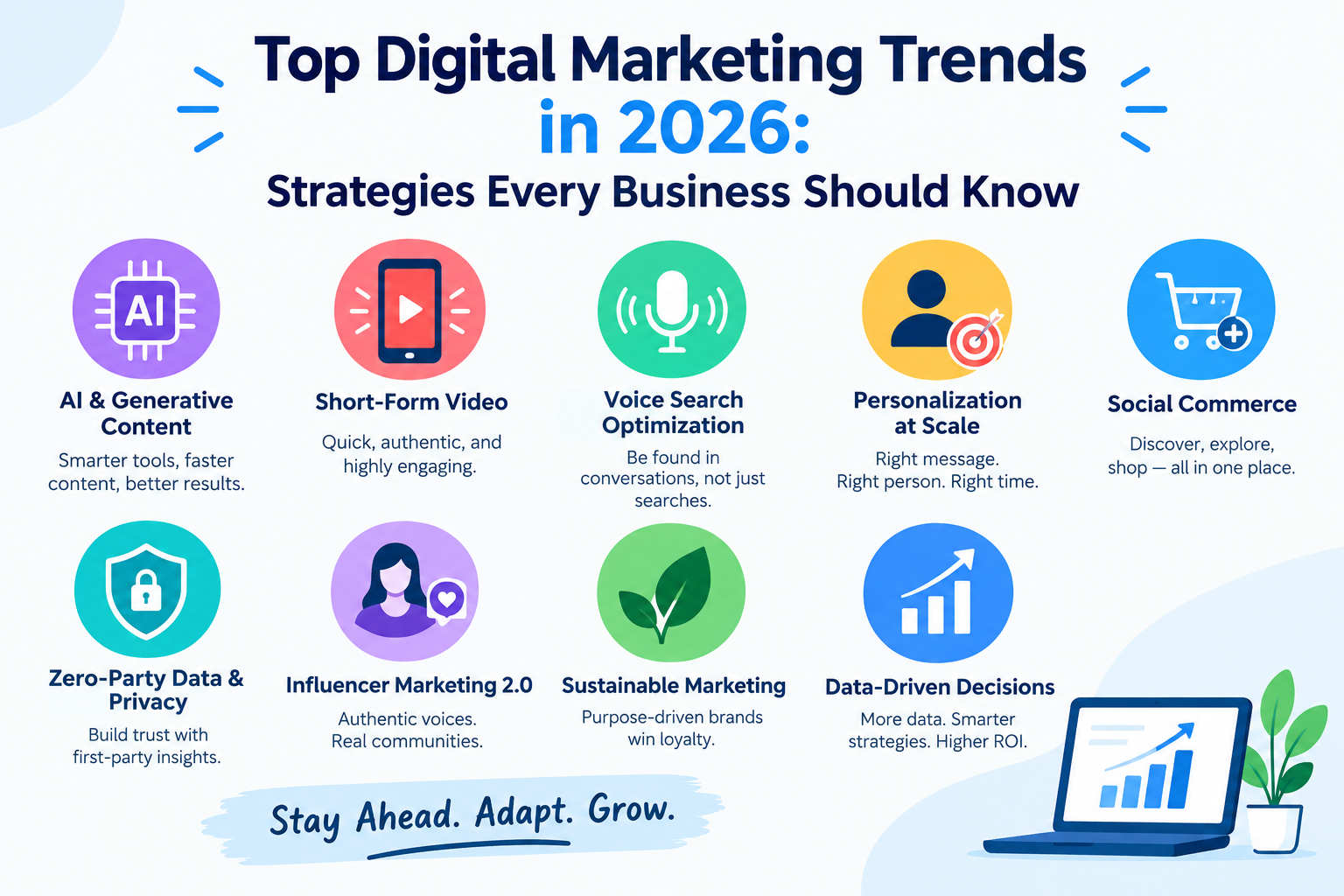

Digital marketing continues to transform how businesses attract customers, build brand awareness, and increase revenue. As consumers spend more time online, companies must adapt their marketing strategies to changing technologies, customer expectations, and digital platforms. Strategies that delivered results a few years ago may no longer be sufficient to maintain a competitive advantage.
In 2026, artificial intelligence (AI), personalized customer experiences, evolving search behavior, short-form video, and data-driven advertising are influencing the digital marketing landscape. Businesses are also exploring new ways to reach audiences through AI-powered search engines, social commerce, and conversational marketing.
However, adopting every new technology is not the key to success. Businesses need to identify the trends that align with their objectives, understand their target audience, and measure performance consistently.
Whether you manage a small business, work in marketing, or run an established company, understanding these developments can help you create more effective campaigns. Let us explore the most important digital marketing trends in 2026 and how businesses can use them to achieve sustainable growth.
1. Artificial Intelligence Is Transforming Digital Marketing
Artificial intelligence has become an important part of modern marketing operations. Marketers use AI-powered tools to generate content ideas, analyze customer behavior, automate repetitive tasks, and improve advertising performance.
AI can also help businesses identify patterns in customer interactions and make informed decisions about campaign targeting. For example, an online retailer can analyze purchasing behavior to recommend relevant products, while a service company can use automated systems to prioritize incoming leads.
Common applications of AI in digital marketing include:
Generating content outlines and creative ideas.
Automating email campaigns and customer responses.
Analyzing advertising performance.
Predicting customer preferences and purchase intent.
Personalizing website experiences and product recommendations.
Despite these advantages, human oversight remains essential. AI-generated content should be checked for accuracy, originality, relevance, and brand consistency. Businesses that combine automation with human expertise can create marketing experiences that are both efficient and trustworthy.
2. SEO Is Evolving With AI-Powered Search
Search engine optimization remains an important source of organic traffic, but the way people discover information is changing. Users increasingly expect direct answers, conversational recommendations, and summarized information rather than simply browsing a list of links.
AI-powered search experiences have introduced additional opportunities for businesses to become visible. Alongside traditional SEO, marketers are exploring Answer Engine Optimization (AEO) and Generative Engine Optimization (GEO) to improve how their content appears in AI-generated answers.
To adapt, businesses should focus on creating useful, reliable, and clearly structured content. Helpful articles, original research, detailed service pages, expert insights, and answers to specific customer questions can strengthen online visibility.
Important practices include:
Researching search intent rather than relying only on keywords.
Using descriptive headings and concise explanations.
Maintaining accurate business information.
Building credible backlinks and relevant industry mentions.
Demonstrating experience and expertise through original content.
Updating outdated information regularly.
AI search does not make traditional SEO obsolete. Instead, it expands the ways content can be discovered. Businesses should monitor organic traffic, qualified leads, conversions, and brand visibility across available search channels.
3. Short-Form Video Continues to Capture Attention
Short-form video remains a powerful format for communicating ideas quickly and engaging audiences. Platforms such as Instagram Reels, YouTube Shorts, and TikTok allow businesses to present products, demonstrate services, and share useful information in an accessible format.
Video can also make complex topics easier to understand. A software company might publish a brief tutorial, a restaurant could showcase its preparation process, and a professional services firm could answer frequently asked customer questions.
Successful short-form videos generally have a clear purpose, an engaging opening, and a focused message. Rather than trying to communicate everything in one clip, marketers should concentrate on one useful idea.
Businesses can experiment with several formats, including:
Quick tutorials and demonstrations.
Behind-the-scenes videos.
Customer testimonials and success stories.
Frequently asked questions.
Product comparisons and practical tips.
Short interviews with industry professionals.
Consistency matters more than expensive production. Clear audio, good lighting, captions, and authentic communication can make simple videos effective. Reviewing watch time, shares, saves, and website visits helps marketers identify the formats that resonate with their audiences.
4. Personalization Is Becoming More Important
Customers increasingly expect businesses to understand their needs and provide relevant recommendations. Generic messages may struggle to attract attention when audiences receive large volumes of promotional communication every day.
Personalized marketing uses available customer information to make interactions more relevant. This could involve recommending products based on browsing history, sending emails based on previous purchases, or displaying content that matches a visitor’s interests.
For example, an online learning platform might recommend courses according to a learner’s selected career goals. A travel company could suggest destinations based on a customer’s stated preferences.
Effective personalization requires more than adding a person’s name to an email. Businesses should consider customer interests, behavior, purchase stage, and communication preferences.
At the same time, personalization must respect privacy. Companies should collect only necessary information, explain how it will be used, and provide appropriate choices to customers. Relevant communication builds trust, while excessive tracking or intrusive messages can damage the customer relationship.
5. First-Party Data and Privacy-Focused Marketing
Data plays a significant role in digital marketing, but businesses must collect and use it responsibly. Changes in privacy expectations, browser technologies, and advertising regulations have encouraged marketers to strengthen their first-party data strategies.
First-party data is information a business collects directly through interactions with its customers and website visitors. Examples include newsletter subscriptions, customer feedback, purchase records, and preferences voluntarily shared through forms.
This information can help businesses understand their audiences and create more relevant campaigns without relying entirely on external tracking sources.
Companies can strengthen their first-party data strategy by:
- Offering useful resources in exchange for voluntary subscriptions.
- Creating clear newsletter and registration forms.
- Maintaining accurate customer relationship management records.
- Asking customers about their preferences.
- Reviewing consent and data retention practices.
- Restricting access to sensitive customer information.
Businesses should also ensure that their data practices comply with applicable privacy laws. Responsible data collection supports better targeting while helping maintain customer confidence.
6.Influencer Marketing Is Moving Toward Authenticity
Influencer marketing continues to help brands reach audiences through creators who have established relationships with their followers. However, businesses are increasingly evaluating partnerships based on relevance, credibility, engagement quality, and measurable results rather than follower counts alone.
Micro-influencers and niche creators can be valuable because they often serve clearly defined communities. A regional food business, for instance, may benefit more from collaborating with a trusted local food creator than from hiring a celebrity with a broad but less relevant audience.
Effective influencer campaigns begin with clear objectives. Brands should identify the audience they want to reach, select creators whose content aligns with their values, and agree on realistic performance indicators.
Campaign results can be measured through referral traffic, discount-code usage, enquiries, conversions, and audience engagement.
Authenticity is particularly important. Audiences are more likely to respond positively when creators provide honest opinions and explain a product’s practical value. Sponsored partnerships should be disclosed appropriately, and businesses should avoid making unsupported claims about products or services.
7.Social Media Is Becoming a Search and Shopping Channel
Social media platforms are no longer used only for entertainment and communication. Many consumers also use them to discover products, research businesses, compare options, and seek recommendations.
This shift creates opportunities for brands to improve their visibility by publishing searchable, useful, and engaging content. Clear captions, relevant keywords, informative videos, and accurate profile details can help users understand what a business offers.
Social commerce also allows eligible businesses to connect product discovery with purchasing. Depending on the platform and market, customers may browse product catalogues, explore tagged products, or move directly to a business website.
To make social media more effective, businesses should:
- Publish content suited to each platform.
- Answer questions in comments and direct messages.
- Maintain accurate contact and product information.
- Use customer reviews and demonstrations responsibly.
- Provide a clear path from discovery to purchase.
- Track sales and enquiries generated by social campaigns.
The goal is not simply to increase followers. Businesses should use social platforms to build relationships, support customers, and create measurable opportunities for growth.
8.Omnichannel Marketing Creates Consistent Customer Experiences
Customers often interact with a business through several channels before making a purchase. They may discover a brand on social media, read a blog, compare services on its website, and eventually contact the sales team.
Omnichannel marketing connects these interactions to provide a more consistent customer experience. Instead of treating every platform as a separate marketing activity, businesses coordinate messaging, customer information, and campaign objectives across channels.
For example, a customer who downloads a product guide could receive a relevant follow-up email. If the customer later contacts the sales team, the team can use appropriate interaction history to continue the conversation without asking the same questions repeatedly.
An effective omnichannel strategy requires clear processes and suitable technology. Website analytics, email platforms, customer relationship management systems, and advertising dashboards can help teams coordinate their activities.
Businesses should also ensure that messaging reflects each platform’s purpose. A detailed email, a short social post, and a landing page can communicate the same core message without using identical content everywhere.
9. Performance Marketing Is Becoming More Data-Driven
Performance marketing focuses on measurable outcomes such as leads, purchases, registrations, and qualified enquiries. Businesses can use paid search, paid social media, display advertising, and other digital channels to reach specific audiences and evaluate campaign effectiveness.
Modern advertising platforms offer automated bidding, audience optimization, and campaign recommendations. These capabilities can improve efficiency, but they do not eliminate the need for strategic planning.
Before launching a campaign, marketers should define their objectives, understand customer acquisition costs, and establish a realistic budget. They should also ensure that landing pages offer a relevant experience and make the next step clear.
Important performance indicators include:
Click-through rate (CTR).
Cost per click (CPC).
Cost per lead (CPL).
Conversion rate.
Customer acquisition cost (CAC).
Return on advertising spend (ROAS).
No single metric tells the entire story. A campaign that generates inexpensive leads may still perform poorly if those leads rarely become customers. Businesses should evaluate lead quality, revenue, and profitability alongside advertising costs.
10.Conversational Marketing Improves Customer Engagement
Conversational marketing helps businesses interact with potential customers through live chat, messaging applications, chatbots, and other communication tools. These channels can make it easier for users to ask questions and obtain relevant information.
AI-powered chat interfaces can respond to common enquiries, explain service options, and direct visitors toward appropriate resources. For businesses that receive enquiries outside normal working hours, automated assistance can provide an additional layer of support.
However, automated conversations should be designed around actual customer needs. A chatbot that repeatedly provides irrelevant responses may frustrate visitors instead of helping them.
Businesses should develop clear conversation flows, use reliable information, and provide an option to contact a human representative when necessary. Sensitive requests and complicated issues may require direct human attention.
The effectiveness of conversational marketing can be measured through response times, enquiry completion rates, customer satisfaction, and the number of qualified leads generated.
11.Content Marketing Must Demonstrate Real Value
As content creation tools become more accessible, publishing large volumes of material is no longer enough to stand out. Businesses need content that addresses genuine customer concerns and offers something more useful than a general overview.
High-quality content can take many forms, including detailed guides, case studies, original research, expert interviews, educational videos, and practical checklists.
For example, a digital marketing agency could publish a case study explaining how it improved a client’s lead generation process. A cybersecurity company might create a guide to common online risks and appropriate preventive measures.
A strong content strategy should begin with audience research. Marketers need to understand what customers want to learn, which questions influence purchasing decisions, and where existing information falls short.
Content should also be reviewed periodically. Updating statistics, correcting outdated recommendations, improving internal links, and adding new insights can maintain its usefulness over time.
The objective is to establish credibility, support customers throughout their decision-making process, and connect content engagement with meaningful business outcomes.
12.Marketing Analytics and Continuous Optimization
Digital marketing produces a wide range of performance data, but collecting numbers is only the first step. Businesses must interpret those numbers and use the findings to improve their strategies.
Analytics tools can reveal which channels generate visitors, which pages encourage enquiries, and where potential customers abandon a conversion process. These insights help marketers allocate resources more effectively.
For instance, if a landing page receives substantial traffic but few enquiries, the problem may involve unclear messaging, slow loading times, or a complicated form. Testing different headlines, calls to action, and page layouts can help identify improvements.
A practical optimization process includes:
- Establishing measurable campaign objectives.
- Tracking relevant performance indicators.
- Reviewing results at regular intervals.
- Identifying weaknesses and opportunities.
- Testing changes systematically.
- Applying successful findings to future campaigns.
Businesses should avoid making major decisions based on short-term fluctuations alone. Reliable conclusions often require sufficient data, appropriate comparisons, and consideration of external factors.
How Businesses Can Prepare for Digital Marketing in 2026
Keeping up with every new trend can be expensive and distracting. A more effective approach is to prioritize activities that support specific business goals.
Start by reviewing existing marketing performance. Identify the channels that generate qualified leads, the content that attracts meaningful engagement, and the areas where customers encounter difficulties.
Next, select a small number of improvements. A business might introduce AI-assisted workflows, strengthen its SEO strategy, publish more educational videos, or improve email segmentation. Each initiative should have a clear owner, budget, timeline, and measurement plan.
Investing in skills is equally important. Marketing teams need to understand analytics, content quality, privacy practices, creative development, and emerging technologies. Training and experimentation can help employees use new tools more confidently.
Finally, maintain a balance between automation and human judgment. Technology can accelerate research and execution, but customer understanding, creativity, ethical decision-making, and strategic thinking remain essential.
Conclusion
Digital marketing in 2026 is shaped by AI-powered tools, changing search experiences, personalized communication, video content, social commerce, and more responsible data practices. These developments create opportunities for businesses to reach relevant audiences, improve customer experiences, and make better use of their marketing budgets.
However, success does not come from adopting every trend at once. Businesses should focus on understanding their customers, producing valuable content, measuring meaningful outcomes, and improving their strategies consistently.
By combining technology with creativity, trustworthy communication, and data-informed decisions, businesses can build a stronger digital presence and establish lasting customer relationships.
Frequently Asked Questions
Major trends include AI-powered marketing, AI search optimization, short-form video, personalization, first-party data, influencer marketing, social commerce, omnichannel strategies, and performance analytics.
Yes. SEO remains valuable for helping users discover websites through organic search. Businesses should also consider how their content may appear in AI-generated answers and conversational search experiences.
AI helps marketers automate repetitive tasks, analyze data, personalize campaigns, generate content ideas, and improve advertising workflows. Human review remains important for quality, accuracy, and brand consistency.
First-party data helps businesses understand customers through information collected directly and appropriately. It can support relevant communication, audience segmentation, and better marketing decisions.
Small businesses can begin with a mobile-friendly website, useful SEO content, consistent social media activity, targeted email campaigns, and clear performance tracking. They should prioritize affordable initiatives that produce measurable results.