




Not long ago, “we use AI in our ads” was a selling point. Agencies put it in pitch decks. Platforms announced it with fanfare. It was an extra, something you could switch on or leave off.
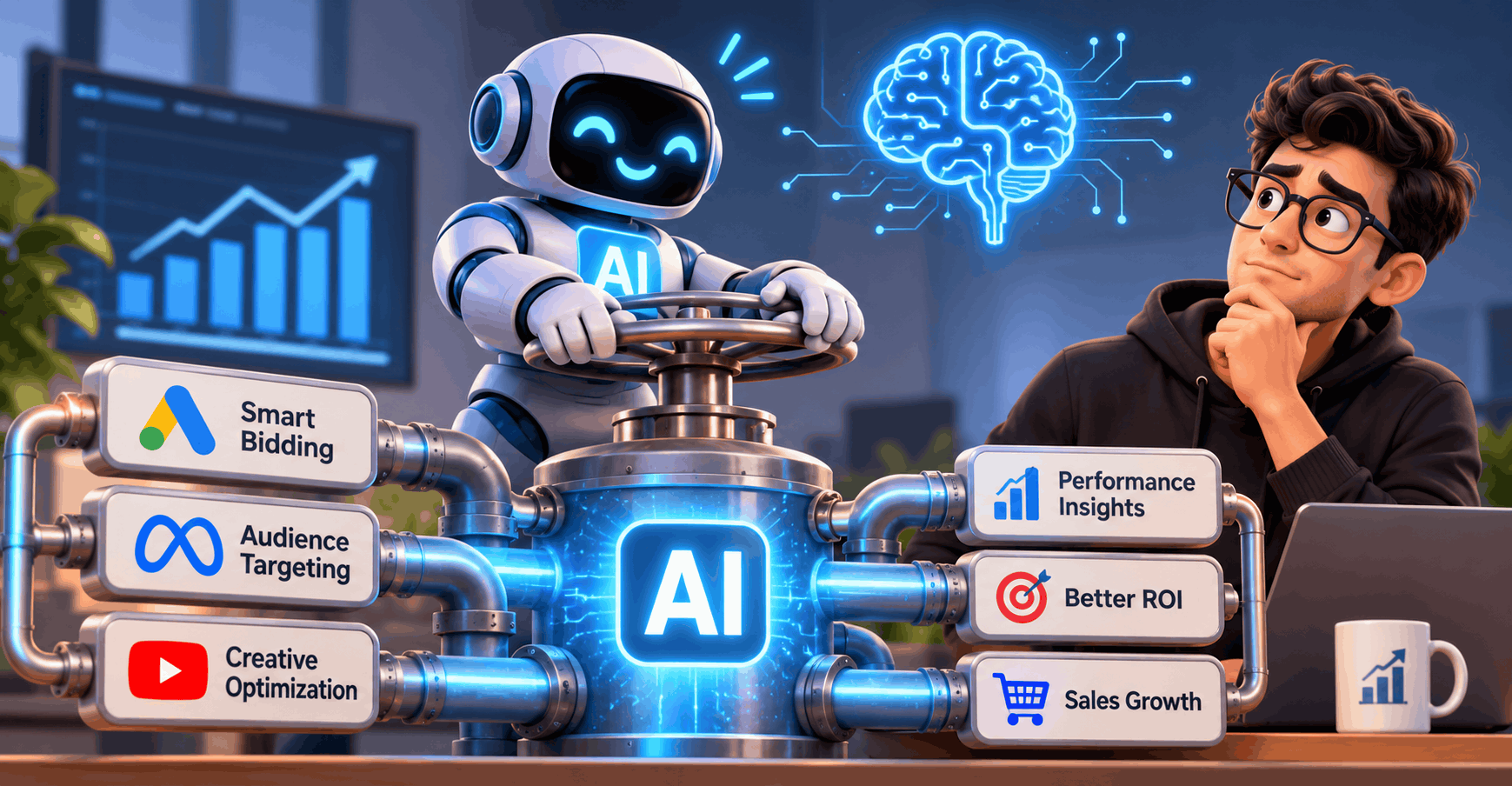
That era is over. In 2026, AI will no longer be a feature of performance marketing. It is the layer everything else runs on. Asking whether you use AI in your campaigns now makes about as much sense as asking whether you use the internet.
This shift changes what the job actually is. Here’s what’s happening, why it matters, and how to stay in control of a system that increasingly runs itself.
From Tool to Operating System
A feature is something you choose to use. Infrastructure is something you build on top of, whether you like it or not.
For years, AI sat inside campaigns as an assist: a bid suggestion here, an audience recommendation there. Today the major platforms have flipped the model. You hand over your goals, creative assets and budget, and the system handles targeting, bidding, placement and pacing.
The adoption numbers show how fast this happened. A March 2026 survey of 200 senior performance marketers found that 91% of those running Google’s Performance Max do so at scale, along with 88% of those running Meta’s Advantage+. That isn’t a trend curve. It’s a new default operating model. Spending follows suit: eMarketer projects AI-powered ad spend will reach $57 billion in 2026, driven largely by Performance Max and Advantage+.
The defaults are shifting too. Google’s AI Max is now the default for new Search campaigns, and Dynamic Search Ads are being migrated onto it by February 2027. Automation is increasingly the starting point, with human controls layered on top rather than the other way around.
Why Marketers Adopted It So Quickly
Marketers aren’t adopting this out of hype. They’re adopting it because it tends to work, at least on the platform’s own terms.
In the same survey, 76% of respondents reported moderate to significant lift from AI-powered solutions like these, and 29% called it significant. The cycle repeats: performance improves, budget moves from manually managed campaigns into automated ones, results improve further, and adoption deepens.
The reasons are straightforward. A machine can evaluate thousands of micro-decisions per hour across bids, audiences, placements and creative combinations. No human team can match that speed or scale, and no one should try. The mechanical work of performance marketing, the daily bid tweaks and audience carving that once filled a week, has been absorbed by software.
The Catch: Infrastructure Has Its Own Politics
Here’s where an honest analysis has to slow down. When AI becomes infrastructure, you inherit the trade-offs of depending on infrastructure that someone else owns.
Reduced visibility. Automated campaign types often show you less. Search term and placement reporting is thinner by design, which makes it harder to understand why something worked or where money actually went.
Self-graded homework. The platforms that run the automation also report the results, usually through their own attribution. Many of the headline lift figures, including Google’s and Meta’s, come from the vendors’ own pages and have not been independently audited. One widely cited Google claim has already been revised downward once, and real-account results vary widely.
Concentration risk. When most of your optimization lives inside two or three platforms, your performance depends on their algorithms, their policy changes and their pricing choices. You’re building on land you don’t own.
Garbage in, amplified out. Automation scales whatever you feed it. Weak conversion signals or messy data make the system optimize confidently toward the wrong outcome.
None of this is an argument against using AI. It’s an argument for using it with open eyes, the way a company relies on cloud infrastructure while still keeping a close watch on costs and security.
What Your Job Looks Like Now
If the machine handles execution, the human role moves upstream and downstream. In practice, a modern performance marketer spends time on five things.
1. Defining what “good” means. An algorithm optimizes toward the goal you set. If that goal is cheap leads, you’ll get cheap leads, including the ones that never close. Strong teams define success in terms of profit, qualified pipeline or customer lifetime value, and feed that into the system as the signal.
2. Protecting signal quality. Conversion data is now your steering wheel. That means accurate revenue values, deduplicated events, server-side tracking, and a CRM that tells the platform which leads turned into customers. Cleaning up your data may be the highest-return task in your whole program.
3. Supplying creativity the machine can’t invent. AI can assemble and vary assets, but it can’t tell you what your customers truly worry about or which angle feels authentic to your brand. Creative strategy, the insight behind the ad, remains stubbornly human. It also stays one of your most flexible levers when targeting options are narrowing.
4. Setting guardrails. Brand safety, exclusion lists, budget caps, geographic limits and approval rules are your governance layer. Decide what the system may do on its own and what needs a human to sign off, before it runs rather than after something goes wrong.
5. Verifying the truth. Because platforms grade their own work, someone has to check it independently. Incrementality tests, holdout experiments and marketing mix modeling tell you whether results are real or merely attributed.
A Practical Framework: Trust, but Verify
Here’s a simple way to operate inside AI-run systems without surrendering control.
Start with a clean foundation. Audit your conversion events and make sure the platform is optimizing toward outcomes that matter to the business.
Feed it your best inputs. Provide varied, high-quality creative built around real customer insight, and give the system room to learn rather than resetting it constantly.
Set the boundaries. Use exclusions, brand controls and budget limits deliberately. Automation without guardrails is just fast drift.
Run independent checks. Every quarter, test one automated campaign with a holdout. Turn it off in a region or for a random audience slice and measure what happens to total sales, not platform-reported conversions.
Keep a manual benchmark. Retain a small, human-managed campaign as a comparison point. If you move everything to automation, you lose the ability to know whether it’s actually better.
Diversify thoughtfully. Avoid depending entirely on one platform’s black box. Consider independent tools or additional channels where your customers truly spend time.
What Comes Next
The direction is clear: more autonomy, not less. Standalone AI agents are starting to manage budgets across several platforms at once, and agent-to-agent buying, where one company’s software negotiates directly with another’s, is beginning to appear. The part that stays constant is that these systems need direction, and direction is a human responsibility.
There’s also a quiet change in how people discover products. As AI assistants summarize options and answer shopping questions directly, being visible to those systems starts to matter alongside traditional ad placement. The marketers who invest in accurate structured data, strong reviews and authoritative content will have an advantage there.
The Bottom Line
AI becoming infrastructure doesn’t make performance marketers obsolete. It makes the thoughtful ones more valuable and the mechanical ones less so.
The teams that win in this environment won’t be the ones who adopt the most automation. Nearly everyone already has. They’ll be the ones who give the machine the best goals, the cleanest data and the sharpest creativity, and who are honest enough to check whether it’s really working.
The algorithm runs the campaign now. Your job is to decide what it should be chasing and to make sure it got there for real.