

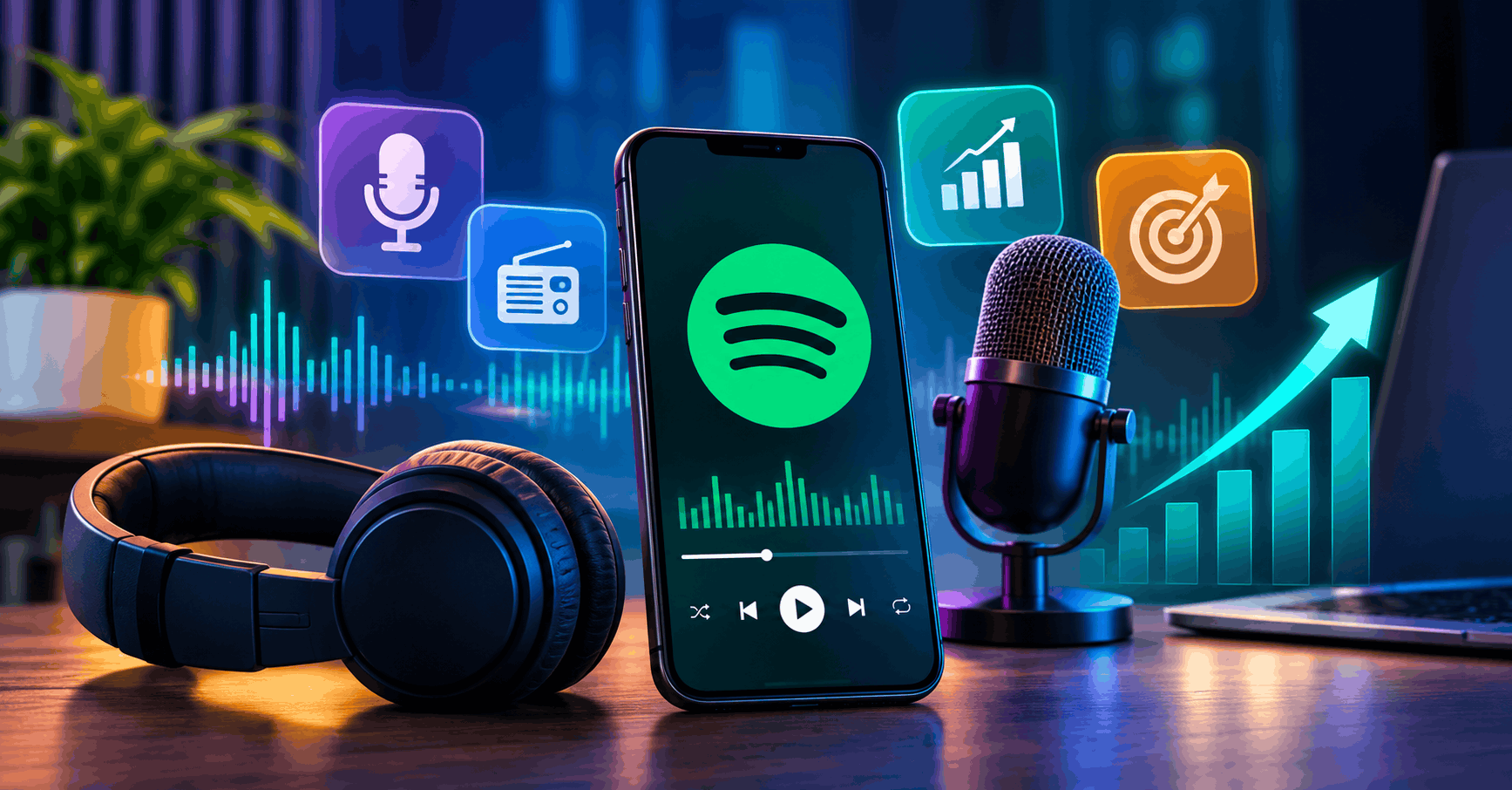



Digital audio advertising means buying ads inside streaming music, podcasts and digital radio. U.S. digital audio ad revenue reached $8.4 billion in 2025, a 10.2% gain, according to the IAB. That makes audio advertising a serious part of any audio marketing plan. This guide covers Spotify ads, podcast advertising, programmatic audio advertising, streaming audio ads and digital radio advertising. You will also learn how to target, budget and measure campaigns.
What Is Digital Audio Advertising and How Does It Work?
Digital audio advertising delivers sound-based ads to listeners over the internet. An app or podcast player requests an ad at a natural break, and the ad is served to that specific listener.
Traditional radio broadcasts one ad to everyone tuned in. Digital delivery lets you choose who hears your ad, cap how often they hear it, and report on delivery. The main environments are music streaming services, podcasts and digital radio simulcasts. For advertisers, the benefits are audience control, flexible budgets and attention during moments when screens are not in use.
Major Types of Digital Audio Advertising in 2026
Spotify Ads and Streaming Audio Ads
Spotify advertising covers audio, video and display formats. Advertisers can buy through the self-serve platform or through programmatic channels. Spotify now describes two biddable buying paths: Spotify Ad Exchange, which opens its inventory to advertisers through DSPs, and the self-serve Spotify Ads Manager. Ads Manager is the rebranded Spotify Ad Studio, so you will see both names online.
Podcast Advertising and Host-Read Podcast Ads
Host-read podcast ads are commercial messages delivered by the podcast host, often as a personal product experience. Other formats include announcer-read spots and sponsorships. Ads can also be baked in, meaning edited permanently into the episode.
Dynamic Ad Insertion
Dynamic ad insertion (DAI) is the alternative to baked-in ads. DAI places ads into chosen pre-, mid- or post-roll slots, targeted to a chosen audience at any time. That lets publishers refresh ads in older episodes.
Programmatic Audio Advertising
Programmatic audio advertising uses software to buy audio inventory automatically, usually through auctions. The next section explains the mechanics.
Digital Radio Advertising
Digital radio advertising places ads in internet streams of radio stations. Unlike traditional radio, it can add listener-level targeting and impression reporting. Availability depends on the station group and the buying platform.
How Does Programmatic Audio Advertising Work?
Audio programmatic buying follows a repeatable sequence:
1. Campaign setup: You set goals, budget, creative, dates and frequency caps.
2. Programmatic audio DSP: A demand-side platform (DSP) is the buying software where you build targeting and bids.
3. SSPs and exchanges: Publishers list ad slots through supply-side platforms (SSPs) and exchanges.
4. Real-time bidding (RTB): When a listener triggers an ad slot, eligible buyers bid in milliseconds, and the winner’s ad plays.
5. Delivery and reporting: You review impressions, completion and conversions in the DSP.
Spotify Ad Exchange
Spotify Ad Exchange activates Spotify’s audio, podcast, video and display inventory inside DSPs advertisers already use, across more than 30 DSPs including The Trade Desk, Display & Video 360 and Amazon DSP. Confirm availability in your market before planning.
Spotify Ads Cost and Minimum Budget in 2026
Spotify does not publish a fixed price list. Audio and video ads in music on Ad Studio run on an auction, and you set a maximum price with a bid cap. Podcast ads on Ad Studio use fixed rates and do not currently run in the auction.
The verified entry point is the campaign minimum. Spotify’s help center states a minimum budget of 250 in your local currency. Spotify’s other pages repeat that figure for the US and Singapore. Actual cost per thousand impressions (CPM) varies by market, format, targeting and competition. An official CPM could not be verified, so none is quoted here. Use the in-platform forecast tool for your campaign.
Small businesses can start with one audience, one creative and a short test. Self-serve gives control, while programmatic buying through a DSP suits larger, multi-channel budgets.
How to Target Audiences with Digital Audio Ads
Common audio ad targeting options include:
• Demographic and geographic: age, gender, and location from region down to ZIP code, depending on the platform.
• Interest and behavioral: Spotify Ad Exchange supports targeting by listening behavior across music, podcasts and playlists, including genre, playlist and podcast category.
• Device and platform: mobile, smart speaker and in-car listening behave differently.
• Retargeting: Spotify supports identity frameworks such as UID2.0 and RampID, which help keep targeting consistent in a DSP.
Contextual Audio Targeting
Contextual audio targeting places ads based on the content being heard, such as a business podcast category, rather than on personal data. It suits privacy-conscious campaigns. Availability varies by platform and country, so check each platform’s documentation.
Professional audiences work best when audio supports other channels. See our guide to LinkedIn Ads in 2026 for B2B audience segmentation.
Host-Read vs Programmatic Podcast Ads: Which Is Better?
| Factor | Host-read | Programmatic |
| Trust | High, personal voice | Lower, announcer-style |
| Scale | Limited to chosen shows | Broad, automated |
| Control | Negotiated per show | Bidding, caps, targeting |
| Cost | Usually higher | Flexible, auction-based |
Pick host-read for authenticity and brand-building. Pick programmatic for reach and testing. Nielsen-cited figures show 71% brand recall for host-read ads against 62% for announcer-read spots.
Best Ad Placement for Podcasts: Pre-Roll vs Mid-Roll
Pre-roll gives the most guaranteed reach, mid-roll gives peak engagement, and post-roll reaches the most loyal but smallest audience. Many campaigns blend slots, using mid-roll for the core message.
AI Audio Advertising, Interactive Ads & Sonic Branding in 2026
AI Audio Ad Generator and AI Voiceover Tools for Spotify Ads
Spotify’s script and voiceover generator lets advertisers create a script, choose a voice by gender and tone, and add background music. It is available in the U.S. and Canada, with the U.K. announced next. Spotify reports more than 20,000 ads generated by over 7,000 advertisers. AI speeds up production, but it does not guarantee performance. Review scripts for accuracy and brand fit.
Interactive Audio Ads and Sonic Branding Strategy
Interactive audio ads invite a response, such as a tap on a call-to-action card. Spotify announced work on formats like call-to-action cards through its Creative Lab. A sonic branding strategy uses a consistent sound, voice or jingle so listeners recognize you without seeing a logo.
Video Podcast Advertising
YouTube accounts for 32% of all U.S. podcast listening time, according to Edison’s Share of Ear study. Video podcast advertising lets one integration reach audio and video audiences.
How to Measure Podcast Advertising ROI and Campaign Performance
Track impressions, reach, frequency, completion rate, clicks (where available), site visits, conversions, cost per acquisition (CPA) and return on ad spend (ROAS). Click tracking is limited in audio, so use:
• Vanity URLs and promo codes
• Post-purchase “How did you hear about us?” surveys
• Lift tests comparing exposed and unexposed audiences
Spotify Brand Lift runs a survey of up to three questions in Ads Manager. For podcasts, look for publishers following the IAB Podcast Measurement Technical Guidelines.
Cross-Channel Audio Measurement
Spotify Ad Exchange supports DSP-native reporting and third-party measurement vendors, so audio can be compared with other channels. Attribution still has gaps. Our explainer on Meta Pixel vs Conversions API shows how to tighten conversion tracking.
Digital Audio Advertising Trends and Statistics in 2026
• Growth: Podcast ad revenue rose 17.6% to $2.9 billion in 2025 (IAB/PwC, April 2026).
• Room to grow: Digital audio is just 2.8% of U.S. digital ad spending.
• Audience: 58% of Americans 12+ listen to podcasts monthly, about 167 million people (Edison Infinite Dial 2026).
• Programmatic: The IAB predicts podcast ad revenue will grow 8.7% in 2026.
Other themes are AI production, omnichannel planning, video podcasts and privacy-conscious measurement.
Programmatic Audio vs Streaming Audio Advertising
Streaming audio is a delivery environment: where the ad plays. Programmatic audio is a buying method: how the ad is purchased. They overlap when you buy streaming audio ads through a DSP. You can also buy streaming audio directly, or through self-serve tools.
| Streaming audio | Programmatic audio | |
| Defines | Environment | Buying method |
| Buying | Direct or self-serve | Automated, auction-based |
| Measurement | Platform reports | DSP and third-party |
Best Podcast Advertising Platforms for Small Business
• Spotify Ads Manager: self-serve, with campaigns starting at $250.
• AudioGo (AdsWizz): a self-serve audio platform. Confirm its pricing directly.
• Publisher networks: Acast uses dynamic ad insertion for audio ads and host-read sponsorships on its network.
• Amazon Ads: its podcast guide covers pre-roll, mid-roll and post-roll ads.
Compare each on minimum spend, targeting, reporting and setup effort. Check availability in your country first.
How to Build an Effective Omnichannel Audio Advertising Strategy
Omnichannel audio campaigns coordinate audio with search, social and video. Spotify-reported data claims audio adds 27% incremental reach beyond TV. Treat this as the vendor’s claim.
• Search: Pair audio with Microsoft Advertising and Google Ads to capture people who search after hearing you.
• Shopping: Retail brands should align audio bursts with a clean Google Merchant Center product feed.
• Social and video: Use Meta and YouTube for reinforcement, with consistent audiences and messaging.
• Sequencing and frequency: Lead with video or social, reinforce with audio, and cap frequency across channels.
• Tracking: Put conversion tracking on every landing page.
FAQs
1. What is digital audio advertising and how does it work?
It is advertising delivered through streaming music, podcasts and digital radio. When a listener reaches an ad break, a platform serves a matched ad. Advertisers can target audiences and measure delivery, unlike broadcast radio.
2. How much do Spotify ads cost in 2026?
Spotify does not publish a fixed price. Audio and video ads in music are auctioned, and podcast ads use fixed rates. The verified starting point is a 250 minimum in local currency. Costs vary by market, format and targeting.
3. How does programmatic audio advertising work?
Advertisers set up campaigns in a DSP. When a listener triggers an ad slot, an exchange runs a real-time auction. The winning ad plays, and the DSP reports results. The process is automated and takes milliseconds.
4. What is the difference between host-read and programmatic podcast ads?
Host-read ads are delivered by the podcast host, so they feel like personal endorsements. Programmatic ads are bought automatically at scale, often through dynamic insertion. Host-read favors trust, while programmatic favors reach and control.
5. How can businesses measure ROI on podcast advertising?
Use vanity URLs, promo codes and post-purchase surveys, then compare conversions and CPA against spend. Brand lift studies and exposed-versus-unexposed tests help when clicks are scarce. No method gives perfect attribution.
6. Is programmatic audio advertising suitable for small businesses?
Sometimes. Self-serve tools like Spotify Ads Manager suit small budgets better than DSPs, which often need more expertise and spend. Start with a small test and check each platform’s minimums.
Conclusion
Choose by goal. Select host-read podcast ads for trust, Spotify Ads Manager for a low-barrier test, and programmatic audio for scale and cross-channel control. Start with a small budget, one audience and clear measurement. Scale only what your data supports.