


In today’s competitive digital Space, businesses are under constant pressure to generate leads, increase sales, improve brand visibility, and demonstrate measurable returns on their marketing investments. From Google Ads and social media campaigns to search engine optimisation (SEO) and content marketing, companies have more opportunities than ever to reach potential customers.
However, many businesses make a comprehensive critical mistake: they treat brand marketing and performance marketing as two separate activities.
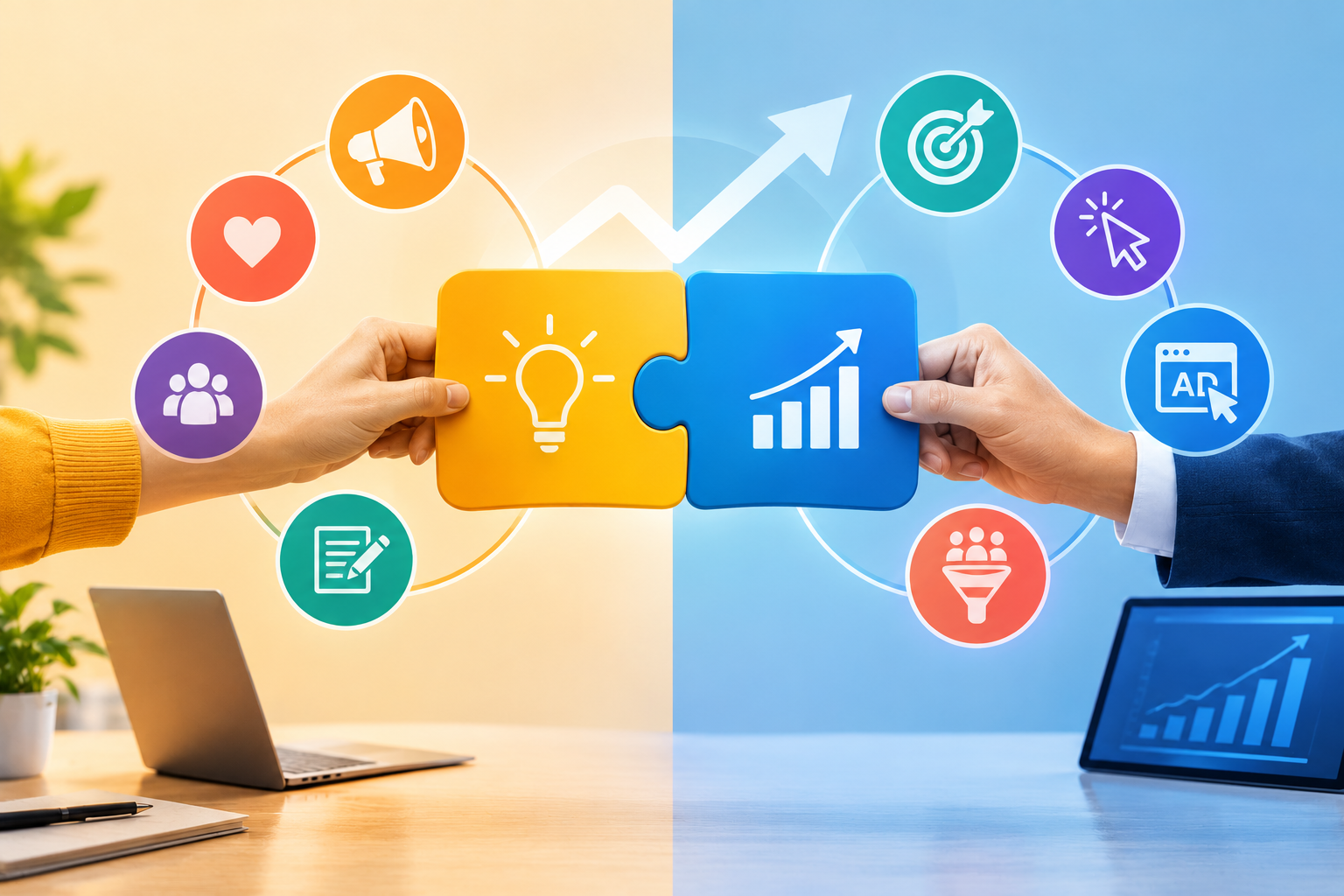
Brand marketing focuses on building recognition, trust, and long-term customer relationships. Performance marketing concentrates on measurable actions such as website visits, enquiries, purchases, and conversions. Although their immediate objectives differ, both contribute to the same business goal: sustainable growth.
When these strategies operate independently, companies may experience inconsistent messaging, inefficient advertising expenditure, and missed opportunities to convert interested audiences into customers.
The solution is not to choose between brand awareness and immediate results. It is to develop an integrated marketing strategy that connects both approaches, allowing businesses to build customer demand while converting it into measurable revenue.
Understanding the Difference Between Brand Marketing and Performance Marketing
Before combining these approaches, businesses need to understand what each one contributes to the marketing process.
What Is Brand Marketing?
Brand marketing focuses on establishing a company’s identity, reputation, and position in the market. It helps potential customers recognise a business, understand its value, and develop confidence in its products or services.
Common brand marketing activities include:
- Social media storytelling and community building.
- Educational blogs and thought leadership.
- Public relations and brand awareness campaigns.
- Video marketing and creative advertising.
- Consistent brand messaging across digital channels.
- Customer testimonials and reputation management.
For example, a digital marketing agency may publish informative articles about SEO, share marketing insights on LinkedIn, and showcase successful client projects. These activities help establish expertise and encourage potential customers to remember the agency when they need professional services.
Brand marketing generally creates value over time rather than producing immediate conversions from every interaction.
What Is Performance Marketing?
Performance marketing focuses on achieving measurable outcomes through campaigns that can be tracked and optimised.
Typical activities include Google Search Ads, paid social campaigns, shopping advertisements, conversion-focused landing pages, and remarketing.
Businesses can measure performance using indicators such as:
- Cost per lead (CPL).
- Customer acquisition cost (CAC).
- Conversion rate.
- Return on ad spend (ROAS).
- Qualified enquiries and sales revenue.
- Cost per acquisition.
For example, a manufacturer might run Google Ads targeting customers searching for a specific industrial product. The campaign directs users to a product page with technical specifications and an enquiry form, helping generate relevant business leads.
The key difference: Brand marketing helps people discover and trust a business, while performance marketing encourages them to take action.
Why Separating Brand and Performance Marketing Can Limit Growth
Businesses often separate brand and performance marketing because their objectives, timelines, and measurement methods differ. However, this separation can create problems when teams fail to coordinate their strategies.
A. Inconsistent Customer Experiences
Customers interact with businesses across multiple channels before making purchasing decisions. They may discover a company through Instagram, read a blog, click a paid advertisement, visit its website, and eventually submit an enquiry.
If each channel communicates a different message, customers may struggle to understand what the business offers.
For instance, a brand campaign might position a company as a premium service provider, while its conversion advertisements focus exclusively on discounts. This inconsistency can weaken brand perception and create confusion.
An integrated strategy maintains consistent messaging, visual identity, value propositions, and customer expectations across every touchpoint.
B. Overdependence on Paid Advertising
When businesses prioritise performance campaigns without investing in brand development, they can become overly dependent on paid traffic.
Paid advertising can generate enquiries quickly, but businesses must continue spending to maintain visibility. If advertising costs rise or campaign performance declines, lead generation may suffer.
Brand recognition, useful content, customer referrals, and organic search visibility can provide additional sources of demand.
Building these assets takes time, but they can strengthen the overall marketing ecosystem and reduce reliance on any single channel.
C. Missing Potential Customers in the Consideration Stage
Not every potential customer is ready to purchase after their first interaction with a brand.
Someone searching for an industrial supplier may need to compare specifications, evaluate reliability, review certifications, and obtain internal approval before contacting a company.
If marketing focuses only on awareness and immediate conversions, these consideration-stage customers may receive insufficient information to make a decision.
Educational content, product comparisons, case studies, email follow-ups, and remarketing can help bridge this gap.
Why Brand Awareness Improves Performance Marketing
Brand awareness and performance marketing are interconnected. A familiar and trusted brand may have an advantage when customers compare alternatives.
When people recognise a company and understand its value, they may be more willing to click its advertisements, explore its offerings, or consider its products.
For example, imagine two businesses advertising similar services. One has consistently published helpful content, maintained an active social media presence, and developed a recognisable brand. The other appears to customers for the first time through a paid advertisement.
The first business may benefit from existing familiarity, although actual results will depend on factors such as pricing, relevance, offer quality, and customer needs.
Brand marketing can also support branded search demand, direct website visits, repeat engagement, and customer referrals.
Businesses should therefore avoid evaluating brand-building activities exclusively through immediate sales attribution. Some campaigns create the awareness and confidence that influence purchasing decisions later.
At the same time, brand investment should have a defined purpose and realistic measurement plan rather than relying on vague claims about visibility.
Building a Full-Funnel Marketing Strategy
A full-funnel marketing strategy connects awareness, consideration, conversion, and retention into one coordinated customer journey.
Stage 1: Awareness — Introduce Your Brand
The objective is to reach relevant audiences and communicate why the business matters.
Useful channels include SEO, social media, educational video content, public relations, and targeted awareness campaigns.
At this stage, businesses can monitor relevant reach, audience engagement, branded search trends, and website visits to assess whether they are reaching the intended audience.
Stage 2: Consideration — Build Trust and Interest
Once potential customers know about a business, they need information that helps them evaluate its products or services.
Useful activities include detailed service pages, comparison guides, customer testimonials, downloadable resources, email nurturing, and case studies.
For a digital marketing agency, this might involve publishing an article explaining how SEO and paid advertising can work together to improve qualified lead generation.
Relevant measures include returning visitors, content engagement, service-page visits, and qualified audience interactions.
Stage 3: Conversion — Encourage Meaningful Action
At this stage, performance marketing helps turn customer interest into enquiries or purchases.
Businesses can use search advertisements, conversion-focused landing pages, remarketing, clear calls to action, and simplified enquiry forms.
Measure conversion rates, cost per qualified lead, sales opportunities, and revenue rather than relying exclusively on clicks or impressions.
Stage 4: Retention — Strengthen Customer Relationships
Marketing should not stop when a customer makes a purchase.
Email communication, customer support, loyalty initiatives, personalised recommendations, and useful educational content can encourage repeat purchases and referrals.
Retention metrics include repeat purchase rates, customer lifetime value, renewal rates, and customer retention.
Connecting all four stages helps businesses build a more complete and effective marketing strategy.
Measuring Brand and Performance Marketing Together
One of the biggest challenges in integrated marketing is measurement. Performance campaigns often produce immediate, trackable results, while brand-building activities may influence customer behaviour over a longer period.
Applying the same short-term conversion metrics to every marketing activity can lead to misleading conclusions.
Instead, businesses should create a shared measurement framework that reflects the purpose of each channel.
| Marketing objective | Relevant metrics |
| Brand awareness | Reach, relevant audience exposure, brand recognition |
| Customer interest | Engaged visits, branded searches, returning visitors |
| Lead generation | Qualified leads, conversion rate, cost per lead |
| Sales performance | Revenue, acquisition cost, ROAS |
| Customer retention | Repeat purchases, retention rate, customer lifetime value |
These indicators should be interpreted together rather than treated as isolated proof of success.
For example, an awareness campaign may increase branded searches over several months, while paid search captures some of the resulting demand. Looking only at the final advertising click may understate the contribution of earlier brand exposure.
Businesses can improve measurement by combining analytics data, CRM records, customer surveys, controlled experiments, and longer-term performance reviews where appropriate.
No single attribution model can perfectly capture every influence on a purchasing decision. The goal is to establish a consistent, useful view of marketing performance that supports better budget decisions.
Practical Ways to Integrate Brand and Performance Marketing
Businesses do not necessarily need a major organisational restructure to improve collaboration. They can start with a few practical changes.
Share campaign plans early. Brand and performance teams should coordinate messaging, audience priorities, creative assets, and campaign timing before activities launch.
Use consistent brand messaging. Advertisements, landing pages, social media content, and website copy should communicate a recognisable value proposition.
Create content for every funnel stage. Combine awareness-focused resources with consideration-stage information and conversion-focused calls to action.
Connect marketing data. Bring website analytics, advertising results, lead quality, and sales outcomes into a shared reporting process.
Allocate budgets strategically. Invest according to business objectives, available resources, audience reach, and evidence of incremental impact. Avoid increasing spending on a channel simply because its results are easier to measure.
Review performance regularly. Identify where potential customers disengage, which messages resonate, and which activities contribute to qualified leads and revenue.
These improvements help businesses move from disconnected campaigns towards a coordinated growth strategy.
Conclusion
Brand marketing and performance marketing should not compete for attention or budget. They serve different purposes within the same customer journey, and both are essential to sustainable business growth.
Brand marketing creates recognition, trust, and demand. Performance marketing captures existing interest and turns it into measurable actions. When these approaches operate together, businesses can deliver consistent customer experiences, make better use of marketing budgets, and develop stronger relationships with their audiences.
For businesses looking to improve their digital presence, the priority should be to connect brand awareness, SEO, content marketing, paid advertising, and conversion optimization through a shared strategy.
At SmartFish Designs, an integrated digital marketing approach can help businesses strengthen brand visibility, attract relevant audiences, and turn customer interest into meaningful enquiries. By combining creative brand development with data-driven performance marketing, businesses can build a stronger foundation for long-term growth.