


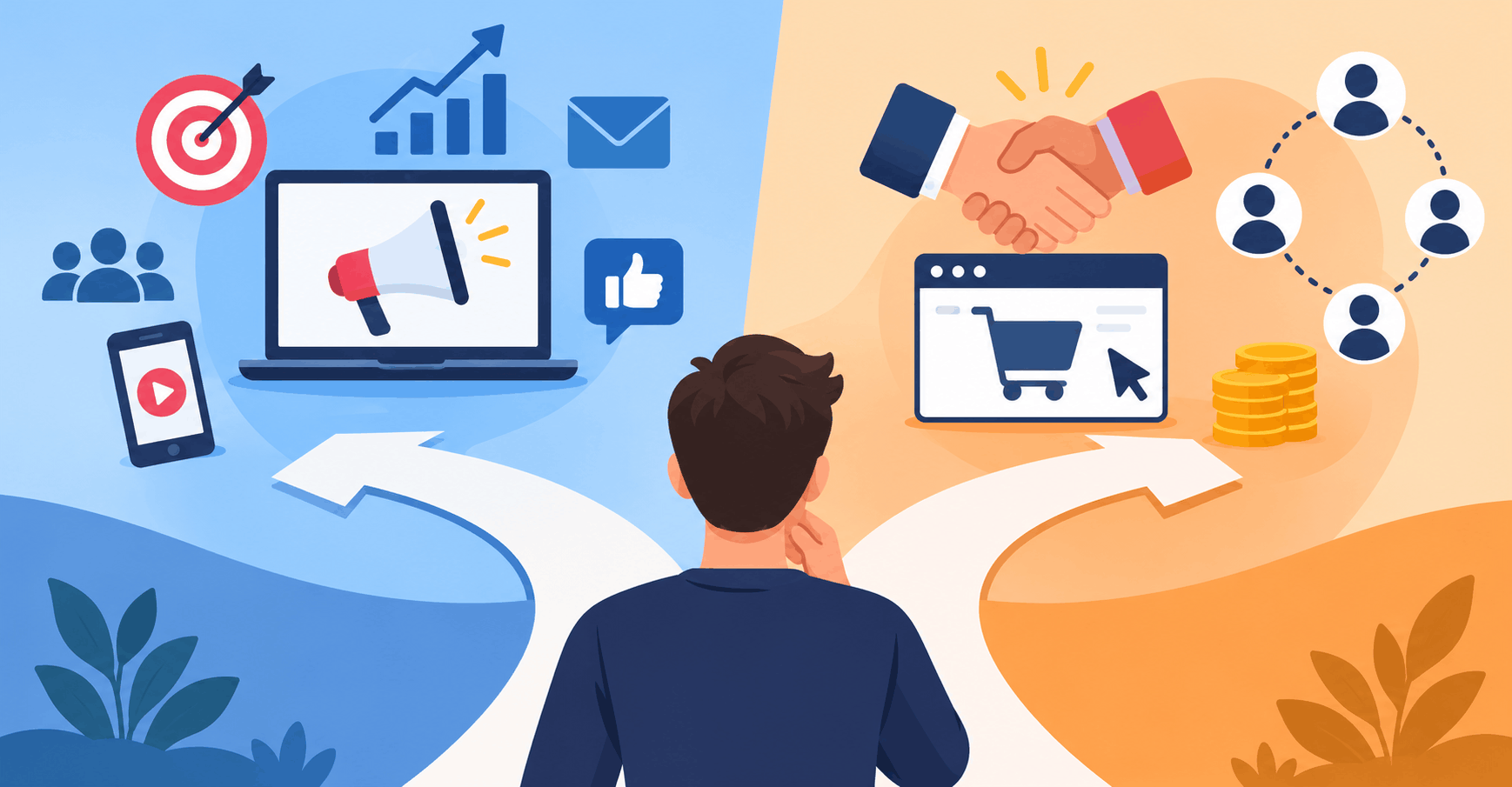


Every business owner eventually hits the same question: where should the next rupee, dollar, or hour of marketing effort go? Two options come up again and again: building a broad digital marketing presence, or setting up an affiliate program and letting partners sell for you.
The confusing part is that these two aren’t really rivals. Affiliate marketing lives inside the larger world of digital marketing. The real question isn’t “which is better?” but “which should I lean on first, given where my business is today?” This guide breaks down how each works, where each shines, where each hurts, and how to decide.
The short version
Digital marketing is the full toolkit for reaching customers online: your website, search visibility, social media, email, ads, and content. You run it, you own it, and you control every message.
Affiliate marketing is one specific tactic within that toolkit. You recruit bloggers, creators, reviewers, or other businesses to promote your product, and you pay them only when their referral leads to a sale (or another agreed action).
Think of digital marketing as running your own shop, window displays, signage, and staff included. Affiliate marketing is like having independent sellers recommend your shop to their own followers and collecting a finder’s fee only when someone actually buys.
Side-by-side comparison
| Factor | Digital marketing | Affiliate marketing |
| Who does the promoting | You and your team | Outside partners |
| Audience | Built and owned by you | Borrowed from affiliates |
| Control over messaging | Complete | Partial; you set guidelines, they interpret them |
| How you pay | Upfront spend on tools, content, ads, talent | Mostly commission after a sale |
| Speed | Slower, compounds over time | Can be fast if partners have reach |
| Tracking | Several analytics tools to learn | Dedicated affiliate platform |
| Main risks | Competition, algorithm shifts, wasted ad spend | Partner dependence, low-quality or dishonest affiliates |
| Best for | Brand building and long-term demand | Driving sales and testing new audiences |
How digital marketing works
Digital marketing meets people where they already spend their time: searching, scrolling, reading email, and watching videos. Most strategies fall into two camps.
Organic efforts
These are the slow-burn tactics that don’t require paying for each click. You publish helpful content, optimize your site so search engines can surface it, grow a social following, and nurture subscribers through email. Results take months, but the audience you build keeps paying off, and it’s yours.
Paid efforts
Here you buy attention directly through search ads, social ads, sponsored placements, or influencer deals. Paid campaigns can put you in front of a precisely targeted audience within days. The catch: when the budget stops, the traffic usually does too.
Why the two work best together
Paid campaigns give you momentum and quick data about what resonates. Organic work turns that early attention into trust and repeat business. Businesses that rely on only one tend to feel either slow or expensive.
How affiliate marketing works
Affiliate marketing is performance-based. Here’s the typical flow:
- You set up a program with clear commission rates and rules.
- Each affiliate receives a unique tracking link.
- They share your product with their own audience through reviews, tutorials, newsletters, videos, or social posts.
- When someone buys through that link, the platform records the sale.
- You pay the affiliate their commission.
The appeal is obvious: you’re not paying for exposure that doesn’t convert. Affiliates, meanwhile, earn income from recommendations their audience already trusts. To run a program well you’ll need tracking software, a sensible payout structure, and the time to recruit, support, and monitor partners.
Strengths and weaknesses
Where digital marketing wins
- Full creative control. Your brand voice, your visuals, your rules.
- Owned assets. An email list or high-ranking website can’t be taken away by a partner leaving.
- Flexibility. You can pivot channels, budgets, and messages whenever the data says so.
Where digital marketing struggles
- Time to traction. SEO and content take patience.
- Upfront investment. Tools, creative work, and ad budgets add up before revenue shows.
- Skill demands. You need to understand analytics, platforms, and constant algorithm changes.
Where affiliate marketing wins
- Pay-for-results model. Spending is tied to actual sales.
- Trusted voices. A recommendation from a creator someone follows often carries more weight than an ad.
- Faster reach. One strong partner can open an audience that would take you years to build.
Where affiliate marketing struggles
- Less control. Affiliates will describe your product in their own words, and not always accurately.
- Dependence. If your top partners go quiet, sales can drop overnight.
- Fraud and bad behavior. Some affiliates use misleading claims, cookie stuffing, or fake traffic to inflate commissions.
- Management overhead. Recruiting, onboarding, and supporting partners is real, ongoing work.
How to choose: five questions to ask yourself
1. What is my main goal right now?
If you need recognition, authority, and a loyal audience, invest in broader digital marketing. If you already have a product people want and mainly need more buyers, an affiliate program can accelerate that.
2. How much have I already established?
Affiliates are far more willing to promote a brand with a polished website, clear positioning, and some social proof. If you’re brand new, build that foundation first. A program launched too early often attracts few partners and weak results.
3. What can I realistically spend, in money and in time?
Digital marketing demands upfront budget or lots of hands-on hours. Affiliate programs reduce promotional spend but add setup costs, commission planning, and relationship management. Be honest about which resource you’re shorter on.
4. Where does my audience hang out?
If your customers are scattered across channels, a multi-channel digital strategy gives you more reach. If your product serves a tight niche with well-known voices (say, specialist software or hobby gear), affiliates who already own that audience can be a shortcut.
5. How much control do I need over my message?
Regulated products, premium brands, or anything requiring precise claims call for tight control. If that’s you, lean toward owned digital channels, or run an affiliate program with strict guidelines and approval processes.
A practical roadmap for most businesses
For most small and growing businesses, the smartest answer is a sequence rather than a choice:
- Lay the foundation. Build a fast, credible website and set up basic analytics.
- Create your core assets. Start publishing useful content and collecting email subscribers.
- Add targeted paid tests. Use small budgets to learn which messages and audiences convert.
- Launch an affiliate program. Once you have proof that your offer sells, invite partners with clear commissions, good creatives, and honest guidelines.
- Review and rebalance. Track revenue per channel, cut what underperforms, and double down on what works.
Common mistakes to avoid
- Treating affiliate marketing as passive. It needs ongoing communication, fresh materials, and fraud monitoring.
- Skipping measurement. Whichever route you choose, define the numbers that matter (cost per acquisition, conversion rate, revenue per partner) before you start.
- Chasing every channel at once. Spreading thin often produces mediocre results everywhere. Master one or two first.
- Setting commissions that don’t add up. Make sure payouts still leave a healthy margin after refunds and other costs.
Conclusion
Digital marketing and affiliate marketing aren’t opposing camps. One is the broad discipline, the other a performance-driven tactic inside it. Digital marketing builds the brand and the audience you own over the long run. Affiliate marketing lets you borrow other people’s trust to drive sales while paying only for results.
If you’re early and still shaping your brand, start with the foundations of digital marketing. If your offer is proven and you want to scale sales, bring in affiliates. And once both are running, let your data decide how to split your effort.
Frequently asked questions
Is affiliate marketing a type of digital marketing?
Yes. It uses online channels and tracked links to promote products, which puts it firmly under the digital marketing umbrella.
Which one is cheaper to start?
Affiliate marketing usually has lower promotional spend since you pay on results, but you’ll still need tracking tools and time to manage partners. Digital marketing can start small, though costs grow as you add ads, tools, and content production.
Which delivers results faster?
Affiliate marketing can move quickly if you land partners with engaged audiences. Organic digital marketing is slower but builds lasting momentum, while paid digital campaigns can also produce quick results.
Can I use both at the same time?
Absolutely, and most successful brands do. Digital marketing creates awareness and trust, and affiliates extend your reach and push conversions.
What skills help most in these fields?
SEO, content creation, data analysis, social media management, paid advertising, and relationship management are valuable across both.